
Want to learn more about the podcast and explore more episodes? Click here to check out our podcast homepage!
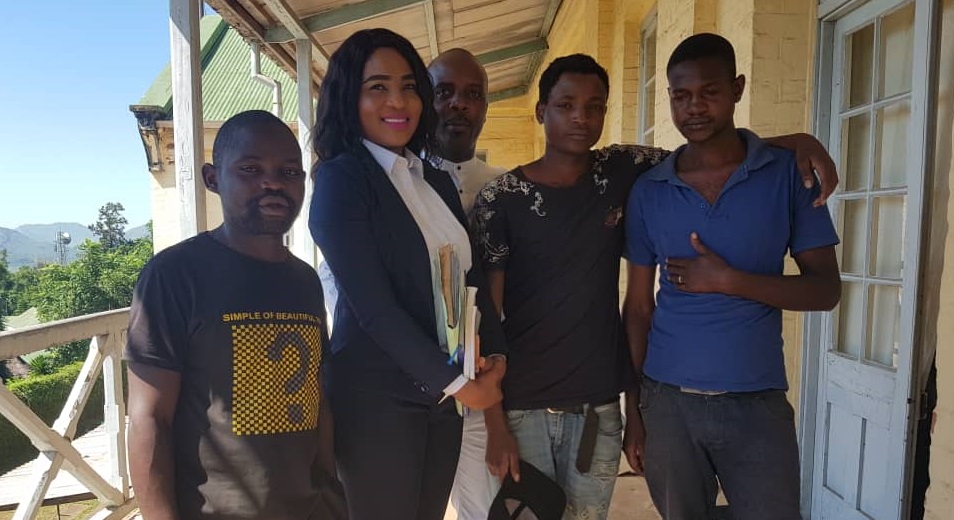
Three men charged with the offense of “rogue and vagabond” in Malawi stand for a photo with their representative legal team from CHREAA & SALC in Malawi. (Photo courtesy of SALC.)
On March 27, 2018, in an area of Malawi called Kasungo District, three men were arrested in a police sweep. The men demanded to know why they were being arrested, but got no response. The next morning, they were brought to court, where they were charged and convicted with the offense of being a rogue and vagabond.
In this episode, our final episode of the season, we’re going to the streets of Malawi, where some communities face police brutality on a daily basis. We follow two grassroots justice organizations- Center for Human Rights Education, Advice and Assistance (CHREAA), and Southern Africa Litigation Centre (SALC). These organizations are building community power among the most marginalized to not only put an end to police abuse, but to transform the relationship between the police and citizens into one that’s grounded in dignity and respect.
Special thanks to Anneke Meerkotter of SALC and Ruth Kaima of CHREAA.
This episode was produced by Jackie Sofia and Poorvi Chitalkar.
A Common Pot: Stories and Recipes for Grassroots Justice is a production of Namati and the Grassroots Justice Network. Support for “A Common Pot” is provided by IDRC Canada.
Follow the Grassroots Justice Network on Twitter, Facebook and YouTube @grassrootsjn, and share your thoughts with us by emailing community@namati.org.
A Common Pot: Stories and Recipes from Grassroots Justice
Episode 5: CHREAA & SALC, “Vagabonds in Power”
Poorvi Chitalkar, Host [00:00:00] Just a heads up, this episode contains mentions of sexual abuse, rape and child abuse. It’s March 27th, 2018, around 11 p.m., in an area of Malawi called Kasungo District. Even though it’s late, people are out. One man, Sikweya, is selling fish kebabs. Inside one of the bars, there’s music playing and a young man named Henry is DJing. There’s another man, Ishmael, out having a drink, just minding his own business. Suddenly, the police show up. They grab the men and arrest them. The men demand to know why they are being arrested, but get no response. The next morning, Henry, Ishmael and Sikweya are brought to court, where they are charged and convicted with the offense of being a rogue and vagabond. In this episode, our final episode of the season, we’re going to the streets of Malawi, where some communities face police brutality on a daily basis. We’ll follow two grassroots justice organizations, the Center for Human Rights Education, Advice and Assistance, and Southern Africa Litigation Centre. These organizations are building community power among sex workers, informal traders, street-connected children, and others – to not only put an end to police abuse, but to transform the relationship between the police and citizens to one that is grounded in dignity and respect. I’m your host, Poorvi Chitalkar. Stay with us.
Poorvi Chitalkar, Host [00:01:52] [INTRO STING] This is A Common Pot, a podcast where we explore stories and recipes for social justice and systems change from around the world.
Poorvi Chitalkar, Host [00:02:14] All three men, arrested in March 2018, were the victims of what’s called a “police sweep.”
Anneke Meerkotter, SALC [00:02:20] So it’s basically either the police come and sweep off undesirables from the street like a broom, or they swoop on undesirables like an eagle. And the idea is basically that the job of the police is not to prevent crime, but to just get rid of people that they think are undesirable within society.
Poorvi Chitalkar, Host [00:02:42] This is Anneke Meerkotter.
Anneke Meerkotter, SALC [00:02:45] My name is Anneke. I’m the director of the Southern Africa Litigation Centre. We are based in Johannesburg. We work across the whole of Southern Africa, sharing an office with CHREAA in Malawi.
Poorvi Chitalkar, Host [00:03:03] And this is Ruth Kaima.
Ruth Kaima, CHREAA [00:03:03] My name is Ruth Kaima from Malawi. I work with an organization called Center for Human Rights Education Advice and Assistance, CHREAA. I work as a litigation and programs manager.
Poorvi Chitalkar, Host [00:03:20] Together, CHREAA and SALC are working closely with vulnerable communities throughout Malawi, from sex workers and LGBTQ plus communities, to informal traders and street connected children. And they’re combating the unjust and abusive police practices that these communities must face on a daily basis, including police sweeps.
Anneke Meerkotter, SALC [00:03:38] The police are constantly using the law in a way to target people who are poor. And that is exactly what the work of CHREAA and SALC has been about: to try and show how the criminal laws, the policing practices, the entire justice system is actually set up to target the poor for acts that the rich would never be held liable for. And for acts that the police themselves know they can never find someone illegally liable for.
Poorvi Chitalkar, Host [00:04:11] For each community, the experience of a sweep varies. In Malawi, sex work is actually legal. But that doesn’t stop the police from targeting sex workers in sweeps.
Ruth Kaima, CHREAA [00:04:20] The police would just choose to raid, let’s say, a rest house. So the police, you won’t find them going into a hotel – a fancy lodge. They’ll probably target a resthouse they feel is of low class. So it will basically mean barging into rooms of people, invading people’s privacy, and then they will literally sweep everyone they find there. All sex workers will be swept, and they’ll be taken to a police station.
Poorvi Chitalkar, Host [00:04:54] If you are a sex worker and you’ve been arrested, your options are the following…
Ruth Kaima, CHREAA [00:04:59] You have a chance to rescue yourself. Do you have any money? Those who have money, they will pay the police. Those who do not have money, they have two options. To pay the police in-kind, which might mean sleeping with the police by force, in essence being raped, so that they be released. Or, if they really don’t have money, or maybe they’re not willing to sleep with the police officers, then they’ll be left in the police station for even a week.
Poorvi Chitalkar, Host [00:05:29] In the case of informal traders, people who are selling goods on the street, the police will sweep them up and confiscate whatever goods they have with them. Even children who live on the streets are targets. Ruth and Anneke have been working with these communities for 13 years now. Their commitment runs deep.
Ruth Kaima, CHREAA [00:05:51] So when I joined CHREAA, most of the work that we’re doing was mostly helping prisoners and those that were within the criminal justice system. And the one thing that struck me the most was that most of the people that we were working with were very poor and they had no access to any legal representation, advice and assistance, but through the paralegals. And that’s what really drove me much to pursue my career in the legal profession. To not only just provide awareness, but also even provide complete assistance like legal representation.
ARCHIVAL TAPE [00:06:27] …”Apartheid was widely seen as oppression…”
Anneke Meerkotter, SALC [00:06:29] I should credit my parents. I grew up during apartheid in South Africa and my parents were in the struggle against apartheid. They were very active. And I think as children, we grew up being very aware of our privilege, being very aware of the injustices in society.
ARCHIVAL TAPE [00:06:52] …”Unique commonwealth of countries and races, the British Empire.”…
Anneke Meerkotter, SALC [00:06:57] If you look at former British colonies, and there are many throughout Africa, they adopted the Vagrancy Act of 1824 of the UK. And to be honest the same vagrancy laws were also in French colonies and Portuguese colonies throughout Africa. So basically, the entire Africa had vagrancy laws and the vagrancy laws basically criminalizes any person who’s found in a place where they should not be.
ARCHIVAL TAPE [00:07:27] …”On the other side of the globe is another bright jewel in the empire crown.”…
ARCHIVAL TAPE [00:07:30] …”Shouting ‘freedom’ and ‘we want Banda now!'”…
Poorvi Chitalkar, Host [00:07:34] On July 6, 1964, what was known as Nyasaland under the British, declared its independence as Malawi. But 60 years later, colonialism still lives on in the form of old laws and the practices of state institutions.
Anneke Meerkotter, SALC [00:07:50] So post-colonialism, these laws continue to be applied by the police. And the reason why they are applied is because they are so vague.
Poorvi Chitalkar, Host [00:07:59] Now let’s fast forward to 2018, to the story of the three men we started this episode with: Henry, Ishmael and Sikweya.
Anneke Meerkotter, SALC [00:08:08] In this specific case there were three young men who were arrested and they were arrested altogether along with many other people that one evening by the police, as part of a sweeping exercise. And then they were charged with being what is called, “Rogue and Vagabond.” And that offense was basically being found in a place where there is a reasonable suspicion that you are there for unlawful purpose. Now, none of the men were there for unlawful purpose. They were there just doing what they were going to do that evening, very normal, nothing dodgy, anything like that. And when CHREAA came upon them at the police stations, they actually tried to ensure that these men’s cases are taken up, and eventually it led to the filing of a constitutional case.
Poorvi Chitalkar, Host [00:09:02] The constitutional case that CHREAA and SALC filed was twofold. First, it challenged the offense of being a rogue and vagabond. And second, it challenged the exercise of sweeping people: the police engaging in mass arrests without probable cause.
Anneke Meerkotter, SALC [00:09:20] They would arrest random people at different places throughout the evening, and then they would take them to court and have them plead together under one offense the next morning. So, in terms of criminal procedure, that’s just completely unlawful, but it’s allowed because these are people who are poor, who do not have legal representation, and who are not going to object.
Poorvi Chitalkar, Host [00:09:44] This was shaping up to be a landmark case from Malawi.
Ruth Kaima, CHREAA [00:09:48] The coming in of this case was a huge breakthrough. Not only for these clients that are mostly the victims, but even as a society, as a whole, as Malawi. It was the first time that people actually paid attention, you know, to the voices of these marginalized groups.
Anneke Meerkotter, SALC [00:10:08] The court was scathing about the levels of police abuse, about the levels of which police exercise arrests without following the law at all.
Poorvi Chitalkar, Host [00:10:20] On November 8th, 2022, four years after the three men were arrested, the high court ruled that mass arrests were unconstitutional. They gave parliament two years to reform the vagrancy laws, as well as any other laws applied in a similar way. The court’s ruling was a big win.
ARCHIVAL TAPE [00:10:41] Lawyer for the applicants, Chikondi Chijozi of Southern Africa Litigation Centre, expressed happiness, adding the rights of people must be respected at all costs.
Chikondi Chijozi, SALC [00:10:51] The court has given a declaration that the police sweeping exercise, it is unconstitutional and it violates human rights.
Poorvi Chitalkar, Host [00:11:02] Henry, Ishmael, and Sikweya didn’t get to see this win for themselves.
Anneke Meerkotter, SALC [00:11:06] The sad story about all of this is that the actual men involved in the case had died from various causes before the judgment even came out.
Ruth Kaima, CHREAA [00:11:18] So they never got to experience or to have a feel of what it feels like to get justice, now that coming when they are going. I think it’s just one of those sad realities that shows that when we delay justice for a long time, it’s as good as we have denied justice, especially for the vulnerable groups.
Poorvi Chitalkar, Host [00:11:40] In the world of grassroots justice, a court order is often just the beginning. In this case, communities now needed to make sure that Parliament amended the laws in the way that the court had ordered, and after that, ensure that the law would be implemented. But in the meanwhile, cases of police abuse against marginalized groups continued. One such case came across Ruth’s desk from a paralegal named Grace.
Ruth Kaima, CHREAA [00:12:07] Grace is a vibrant lady. When you ask her to say, what drove you, you know, to get into this work, to work with street-connected kids? They had a community service outreach within the Catholic Church where she was going to, and they would do charity work. And then when she came across some of these street- connected kids, she says something just sparked in her. And with time, the children, you know, they looked at her as their auntie, as their only person who can help them.
Poorvi Chitalkar, Host [00:12:46] The kids told Grace about a police officer who was sexually abusing them. CHREAA took up the case. They were worried that the police would not do enough to hold one of their own people accountable. And so they decided to go to the office of the public prosecutor. The prosecutor brought charges against the police officer. But the case was stalled for over a year. And so CHREAA decided to change strategy. They helped the street connected children make a complaint to the Independent Complaints Commission. The ICC was established in Malawi in 2020 to take on complaints from the public against police officers and create more accountability.
Ruth Kaima, CHREAA [00:13:27] They demanded that they wanted the police officer arrested. He was arrested, and his case started progressing in court. But then, as these are children and street-connected kids, they’re vulnerable. I think one thing we’ve learned, at times through the hard way, is that sometimes, yes, legal empowerment also exacerbates the retaliation from state actors.
Poorvi Chitalkar, Host [00:13:53] So, CHREAA placed the kids inside a safe home to protect them from any potential danger. The safe home was protection for the children, but not for Grace.
Ruth Kaima, CHREAA [00:14:04] Somehow, the police officer who was being prosecuted managed to get bail.
Poorvi Chitalkar, Host [00:14:09] The police officer, now out on bail, began tracking Grace’s whereabouts: where she lived, what she did for a living, and places that she would frequent around town.
Ruth Kaima, CHREAA [00:14:20] She was quite traumatized from that ordeal. So when she was actually harassed by the perpetrator- the police officer -that affected her a lot. And she just decided to go under, you know, like to say, okay, I think I need to lie low and- which was also understandable on our part. So this not only affected her, but you know this is also a person that the street connected children have so much trust in her. And then as if that was not enough, the case in court dragged and dragged.
Poorvi Chitalkar, Host [00:15:00] After a year, the kids got restless. They were used to being outside in the streets, free to roam, not cooped up in a house somewhere. Many of them were starting to leave the safe home. Ruth and her team needed to figure out how to keep the momentum going.
Ruth Kaima, CHREAA [00:15:15] We went back to the drawing board and started to engage these children to say, “Okay, let’s look back, you know, a year or two years, backwards. What was the situation like?” And they were able to say, “You know that time we had no hope. There was no way of getting anything.” So we’re like, “Okay, but now at least we’ve managed to have a police officer arrested. Yes, it’s taking long, but he is arrested. He’s answering charges.”
Poorvi Chitalkar, Host [00:15:45] The Complaints Commission was able to hold a police officer accountable. He was arrested- in this case. But it’s not a perfect solution. Funding and staffing shortages at the Commission often result in long delays and people falling through the cracks.
Anneke Meerkotter, SALC [00:16:01] And part of the work is really to push also that these sort of bodies are better supported by parliament so that they are able to respond to the very valid requests from marginalized communities. And so that marginalized communities can even trust them to report their cases. I think when a marginalized person faces extreme abuse and extremely harsh living conditions, when someone like that has the courage and takes the effort – and it’s immense effort to approach institution to complain about the police, and that institution is often inaccessible, yet that person went there – and if that institution isn’t responsive, that is just an indictment on democracy itself.
Poorvi Chitalkar, Host [00:16:56] CHREAA and SALC’s approach can be summed up as challenge when needed and collaborate where possible. When the police commit abuses, they use the full power of the law to hold officers accountable. And they find ways to amp up the pressure. For example, in the case of the street-connected children, they also partnered with the media to publish a story, which created public pressure on the ICC to act. However, charging police officers after they had committed abuse felt like playing catch up. CHREAA and SALC needed to find a way to improve the relationship between the community members and the police, and prevent these abuses from happening in the first place. Meanwhile, in Blantyre, in the same police station where the abusive officer came from, a different officer began talking directly with the street connected children.
Ruth Kaima, CHREAA [00:17:47] This is something that has never happened before. And at least for the kids, they were able to say, “Well, we know that at the police station, at least if you have a chance to meet the one in charge or the boss, these ones, they sometimes listen to us.”
Poorvi Chitalkar, Host [00:18:07] Transforming a relationship where trust has been completely eroded is not easy. But this incident was a sliver of hope that with the right people, change may be possible. It gave CHREAA and SALC inspiration, and they leaned into the moment.
Ruth Kaima, CHREAA [00:18:24] One of the main strategies that we use when we are engaging the state, for example the police officers, is to also make sure that we are not just going there 100 percent point blank to say, you are wrong. Yes, they’re wrong, but we try to provide you know, offer an olive branch to them to say, “Okay, how can we work together?”
Poorvi Chitalkar, Host [00:18:52] With this new approach, CHREAA and SALC began to see a shift in their relationship with the police. Rather than always being on the opposite side of a fight, the two were now talking to each other.
Ruth Kaima, CHREAA [00:19:03] This time, we went to them and say, “You know, we’ve always been on your neck, on your case. Police, you do this, you this, you do this. But I think we’ve never stopped to actually try and listen to say, what are the issues? What are the challenges?” For example, during the COVID, an officer told me, “You know we know the police has received money to assist with patrols, but that money has not trickled down to the junior officers that are doing the work. So we are just frustrated, so we are laying those frustrations by just arresting people.”
Poorvi Chitalkar, Host [00:19:36] They also wondered what would happen if the police and the community members actually talked and listened to each other. And so they tried it with sex workers.
Ruth Kaima, CHREAA [00:19:46] We actually, you know, initiated an engagement to say, “But you don’t just have to look at sex workers as people you can prey on or a group or community that you feel that engaging in some illegal acts. You could also work with the sex workers.” And that has really worked in one of the districts, especially Dedza, whereby the police and sex worker leaders work hand together because the sex workers also sometimes do provide information where they have, they do act like informants for the police officers, maybe if they are aware of a certain criminal act that is happening or that is about to happen. So in that context, the police are bit more open.
Poorvi Chitalkar, Host [00:20:32] CHREAA and SALC realized that the role of individual allies within the greater system is critical. Even when institutions as a whole don’t respond, a person within the institution can help. And it can build understanding on a human level between officers in power and vulnerable communities. These relationships take time to build and SALC and CHREAA take a long-term view.
Ruth Kaima, CHREAA [00:20:58] Most of the times when they get to that police station they will first meet this low-ranked officer maybe at the reception or something. So it becomes really important to create that relationship with this officer. So when you are working with the police, for us one strategy that we use is to make it very clear to say this is work. This is pure professional work, so if I come to you and I’m following up this matter, I’m not attacking you as an individual. I’m attacking you as an officer and as the police, as an institution. You know, today, this officer is a junior ranking officer. Two, three years from now, they’ve been promoted. Then 10 years, they are at the regional offices. Then later, some have even gone up to become even the inspector general of the police. And with time, those relationships, they tend to grow. And then when they grow, we capitalize on those relationships. But most importantly, whenever they also need our help, we also make sure we come through for them. When the police does something that’s very positive, we make sure that we make as much noise that we make when they’ve also done something that we’re trying to hold them accountable. That helps to keep that balance in that relationship going.
Poorvi Chitalkar, Host [00:22:22] This sounds nice when it works out, but tensions do bubble up. Ruth remembers when they thought they had an ally in a senior police officer, but came to find out otherwise.
Ruth Kaima, CHREAA [00:22:34] Much as he was more of an ally, when it come to a specific group of the communities that we work with, for example the street-connected kids, he was the complete opposite. So he would tell it to our face to say, “As long as it has to do with street- connected kids, I can assure you this: I’ll never stop arresting them, I will never stop commanding my officers to go arrest street- connected kids. Those are criminals. Those are terrorizing our cities.” And this is someone who’s well-educated, pro-human rights. Sometimes you have to weigh the situation to say, okay, the way the situation now is we have to retract.
Poorvi Chitalkar, Host [00:23:21] So, what’s the impact? Does it work? CHREAA and SALC have been trying to understand the impact of their work on these communities.
Ruth Kaima, CHREAA [00:23:29] For me, one of the greatest impacts that has come out of this is the actual empowerment itself that’s been accorded to these groups that we’re working with.
Ruth Kaima, CHREAA [00:23:47] [Background: Archival tape of Alice Matambo, Executive Director of the Sex Workers Empowerment Alliance in Dedza] So, I’ll give you an example of sex workers in Dedza who have been, you know, empowered. So, if a sex worker is arrested, for example in Dedza, another sex worker is able to go to the police station, you know, inquire to see why is their friend arrested, or even if they themselves have been arrested, they are able to inquire to say, “Why have you arrested me? What offense are you charging me with?” And what the police usually are aware of is the fact that this sex worker actually knows her rights, She knows that you cannot just arrest her for no reason and then detain her in a police cell for a long time. Then most of the times the police is either, they will release them, or sometimes they would actually ensure that they facilitate the release of these sex workers.
Poorvi Chitalkar, Host [00:24:42] The empowerment that Ruth and Anneke are describing isn’t just at the individual level. They’re seeing a kind of collective empowerment building up within communities.
Anneke Meerkotter, SALC [00:24:52] It is about communities feeling that level of activism and social solidarity to be able to stand up for each other if something happens, and not just for themselves. And you can see in the groups that how people respond to each other, that they’ve been there for each other in those times of crisis.
Poorvi Chitalkar, Host [00:25:11] For Ruth, a major success came out of these organizing efforts recently, when members of these communities, who have been fighting against police abuse, are now themselves in decision-making spaces.
ARCHIVAL TAPE [00:25:27] [Speaking: Loretta Simbeye, Executive Director, Mwanza Cross Border Sex Workers and LGBTQ community organization]
Ruth Kaima, CHREAA [00:25:31] One recent one that really hit me was the last interaction that we had with sex workers and LGBT communities from one of the districts, Mwanza, was that we actually discovered that they have a representation in the big district executive committee. That’s like the top level at the district level. So, that’s why you have the DC representatives of the council, of all the important sectors- health, education – the local leaders, everyone is there. That’s where the decisions are made. And the representative of sex workers is in that committee. For me, I was like, wow, that that’s really huge. So it’s not just about them having access, for example, to the police, but being recognized at the district level… For me, it’s huge, it’s a big win. So I think that was one of the most “A-HA” moments that I can recall.
Poorvi Chitalkar, Host [00:26:37] And while legal empowerment has made a big impact on community power, what about the police? Has their behavior changed?
Ruth Kaima, CHREAA [00:26:46] I guess it’s a yes and no, dependent on the situation and the kind of police officers that you’re dealing with.
Anneke Meerkotter, SALC [00:26:52] Or what we’ve seen work most successfully as opposed to a hostile approach or approach where one complained, is to build relationships. And it might be much harder, but the research has shown that it’s much more effective in effecting change at that local level.
Ruth Kaima, CHREAA [00:27:10] The last time we had a focus group with street-connected children, they were able to say, “Much as maybe we’re still facing some abuses from the police, but at least now we know that there are actually some good police officers, especially the senior police officers. It’s the junior officers sometimes that are giving us problems. But at least they are able to acknowledge, to say now we know that we matter.”
Poorvi Chitalkar, Host [00:27:37] There have been successes, but the work to achieve them takes time. And communities must take on this fight for justice on top of their daily struggle to survive.
Anneke Meerkotter, SALC [00:27:48] All the groups that we work with have internalized the violence. They’ve normalized it. And for them, the most important thing at any point in time is getting food on the table. Whether or not they get arrested in the process and how they would be able to then deal with police abuse, it’s not that they don’t want to deal with police abuse. It’s just any- even laying complaints against police is time taken away from earning money. Even attending meetings with each other is time taken away from earning money. And for me, the issue is then, how do you ensure that those complaints mechanisms understand the calculations people make and then figure out how do we become more accessible? How do we work with better speed?
Poorvi Chitalkar, Host [00:28:40] In this podcast series, we have heard over and over again how communities struggle to keep fighting against the odds, when the process is long and the challenges are overwhelming. They feel frustrated and sometimes lose hope. And we have heard how community organizers and activists struggle to find ways to keep communities engaged. But what about the activists themselves? We asked Ruth if she gets tired. She took a heavy pause before answering.
Ruth Kaima, CHREAA [00:29:12] It’s not just work, but you’re actually dealing with people’s livelihood, their entire source of survival. It really does get to you. Especially, you know, when you give them the hope, you empower them, you let them know the avenues that are there. And sometimes these avenues are not working and they come back to you, it really gets you. Or sometimes when you’re giving them the help that you can afford to, but they feel like that’s not the help that they want. You know, like the example of the informal traders that we keep giving to say, “Their interest is getting their money back, getting their capital, their merchandise back.” And that’s something that we’re not able to provide to them. It really does get to us. And sometimes we do get burnouts. We’ve learned to pause sometimes, to say, “Okay, I think we just need to take a moment, slow down.” And I think those pausing moments, they also help us, you know, to recuperate and then, you know, get ourselves together. And then sometimes you now become- you now get to have better ideas or better strategies that you can work with. But, it is a tough job.
Poorvi Chitalkar, Host [00:30:43] Ruth and Anneke are part of the Grassroots Justice Network, where thousands of justice defenders from around the world walk together and learn from each other. They draw inspiration and strength from this community.
Ruth Kaima, CHREAA [00:30:59] I think just knowing that you’re not alone in this fight, because there are times you feel like you’re, you know, facing hurdles, and then you hear what other organizations are going through, or even maybe just the political environment that they’re working in, but they’re still fighting. I think that on its own really gives, like for me, gives me the motivation and the zeal to keep going and to keep fighting. And when you hear others who’ve been fighting for so many years, and somehow they’ve managed to find a breakthrough after so many year, and maybe on just one thing, and that one thing has led to the other, I think for me that’s one of the most important takeaway that I get from sharing with other practitioners.
Poorvi Chitalkar, Host [00:31:55] Ruth recalls a moment in Nairobi, back in 2023, when members of the network came together to learn from each other’s work. A fellow activist, Megan, who works with informal settlement communities in West Africa, talked with Ruth.
Ruth Kaima, CHREAA [00:32:11] One thing that she said, was it’s really important to listen to what the communities you’re working with really long for or really want. Sometimes it’s easier for you to think that you’d know what is best for them or what would be the best redress to their problems. Only when you sit down and listen to them that you actually realize to say, “Well, my idea makes sense, but that’s not what they want. That’s not the impact they’re looking for.” So that really starts with me and also to ensure that we instill the empowerment in the communities that we’re working with.
Poorvi Chitalkar, Host [00:33:00] When we launched this podcast, we set out to discover innovative recipes for social justice from across the Grassroots Justice Network, strategies that justice defenders are using to build community power and give ordinary people a say in the decisions that affect their lives. In each story, activists have also shared actual recipes, the food kind, that symbolize the struggle and the story, and inspire them. And so, for our last episode of the season, we had to get Anneke and Ruth’s favorite recipes.
Ruth Kaima, CHREAA [00:33:35] Okay, so for me, it’s Nsima, what we call Nsima. Nsima is like a starch. And most of the times, the secret to enjoying the Nsima apart from making sure it’s done properly, it’s the kind of side dish that you would have it with. For example, I love beans. So for me I’m looking at Nsima the way we look at legal empowerment, to say for legal empowerment to be effective you need to use and devise in different kind of strategies. You also ought to make sure that you’re using the right balance, because if you miss the right balance, you may end up maybe victimizing others, or you may ended up destroying the relationship maybe that you’re trying to build with state institutions. And at the same time, the same way that Nsima is dependent on what you have it with, it’s also how, when we are engaging in legal empowerment, it is important maybe to find the right allies. Because if you have the right allies, then legal empowerment will be a success.
Anneke Meerkotter, SALC [00:34:49] And if you ask anyone, what should I eat in Malawi? They say, “Have you had Chambo?” That said, it’s a fish with so many bones that it’s like a really delicate exercise to enjoy- to get to the meat part and actually enjoy the fish. It’s a bit like how life in Malawi also is, and especially how the work is that community-based organizations and activists do with the police, that even those engagements, it’s hard work. But if you can get to the point where you can engage with them in a fruitful manner, you actually get to enjoy the meat and you get to enjoy fruitful relationships and cohesion and understanding. Just don’t swallow a bone. Yes.
Poorvi Chitalkar, Host [00:35:51] This episode was produced by me, Poorvi Chitalkar. Our managing producer is Jackie Sofia. Audio engineering and sound design by Mohamad Khreizat. Editorial support by the Namati Strategic Engagement Team. Additional support by Anuradha Joshi and Catalina Marino. A very special thanks to Anneke Meerkotter of SALC and Ruth Kaima of CHREAA for sharing their story with us. Thanks also to Canada’s International Development Research Centre, whose support makes this work possible. If you enjoyed this episode, please rate this podcast, leave us a review and share it with your friends. We’d love to hear your thoughts. And reviews and ratings help us bring these stories to more people around the world. Also, subscribe and check out other stories in this season from Argentina, Chile, Indonesia and Kenya. A Common Pot: Stories and Recipes of Grassroots Justice is a production of Namati and the Grassroots Justice Network. To join the network, head to www.grassrootsjusticenetwork.o-r-g and follow us on social media- on YouTube, X (formerly Twitter) and Facebook, @grassrootsjn.