
Want to learn more about the podcast and explore more episodes? Click here to check out our podcast homepage!
How does a community preserve its right to determine its own destiny? Especially when decisions are being made without their input? In our first episode, we begin a journey to answer this question. We start in Argentina, where informal settlement communities are claiming a seat at the table to shape decisions that will protect their homes and neighborhoods from environmental pollution.
Along the way, we discover the delicate dance that a grassroots justice organization gets involved in, and what it takes to keep going in spite of the odds.
Special thanks to Catalina Marino and ACIJ – the Civil Association for Equality and Justice in Argentina.
Like this episode? Leave us a review on Youtube!
Subscribe to A Common Pot on Apple Podcasts, Spotify and Youtube.
Follow the Grassroots Justice Network on Twitter, Facebook andYouTube @grassrootsjn, and share your thoughts with us by emailing community@namati.org.
[“A Common Pot” intro sting]
Poorvi Chitalkar, Host [00:00:07] This is “A Common Pot,” a podcast where we explore stories and recipes for social justice and systems change from around the world.
[00:00:31] What would you do if someone else decided how to protect your health and well-being without ever talking to you? If you demanded a clean living environment, and the government’s answer was to force you to leave your home, what would you do? This is what happened in Argentina’s Matanza Riachuelo River Basin, one of the most contaminated waterways in Latin America. In 2010, around 63,000 people living within a section of the river basin got word that they were about to be resettled. For many of them, it came as a total surprise when they stumbled upon the announcement in their local newspaper. Just two years before, in 2008, these same communities had won a big court case in Argentina’s Supreme Court. The court had ruled that the effects of the pollution in their communities along the river basin, which was caused by large corporations in the area, needed to be addressed. The court ordered that the area should be cleaned up and future damage prevented. The ruling was one thing, but how it would be implemented and how the communities would be involved- that was something else entirely. Just because a major ruling is handed down by the court, it doesn’t mean that it will be implemented in the best interest of the communities who are most affected. And in 2010, two years after that Supreme Court order, those who were meant to benefit from it were now being displaced. Which leaves us asking a question that you will hear a lot throughout the series. How does a community preserve its right to determine its own destiny? Especially when decisions are being made without their input? In today’s episode, our first episode, we’re sharing the story of the grassroots justice organization ACIJ and their work to establish and strengthen community participation in two informal settlements in Argentina: Villa Veintiuno Veinticuatro, that’s “Town Twenty-One to (21) Twenty-Four (24)” in English, and Villa Inflamable, that’s “Inflammable Town” in English.
Poorvi Chitalkar, Host [00:02:43] This is the story of the real work that happens after a big win.
Catalina Marino, ACIJ [00:02:56] Hi. Poorvi! Oh, we already messed that up. [Laughing]
Poorvi Chitalkar, Host [00:03:01] This is Catalina.
Catalina Marino, ACIJ [00:03:02] I’m Catalina Marino. I work in ACIJ, The Civil Association for Equality and Justice. ACIJ is a nonprofit organization, and it’s, dedicated to defend the rights for the more disadvantaged groups of society and to strengthen the democracy in Argentina.
Poorvi Chitalkar, Host [00:03:22] One of the most disadvantaged groups in Argentina are those living in informal settlements. AC has been working with Argentina’s informal settlement communities for more than 20 years. Their work in the Matanza Riachuelo River Basin began in 2011.
Catalina Marino, ACIJ [00:03:37] So the river basin is a really big area in Argentina, that includes the Buenos Aires City and 14 other municipalities in the Buenos Aires province.
Poorvi Chitalkar, Host [00:03:47] According to the World Bank, an estimated 10% of Argentina’s population lives within the basins 2000km². That’s about 4 million people.
Catalina Marino, ACIJ [00:03:57] Within this area we have like 1600 informal settlements. But again, this is a really, really big area. Then you have some of these settlements that are like next to the river or really close to them, because the river basin is really, really big. And then you have a small part that are next to the river. So just like clarifiers, like it’s not the same to live in the river basin, that to live next to the river. So according to what residents, say, two decades ago, you could really smell and you can really see the pollution in the river and they smell it every day, especially because within the area, lots of industries were established and they used to dump their waste into the water.
Poorvi Chitalkar, Host [00:04:50] The two communities that we will be talking about today are Villa Inflamable and Villa 21-24. Villa Inflamable is right on the southeastern border of the city of Buenos Aires. Next door is one of the largest petrochemical compounds in the country. A little further inland from the mouth of the river is Villa 21-24.
Catalina Marino, ACIJ [00:05:16] Villa Inflamable is called “Inflamable” – “Flammable” in English – because there was a fire next to the river to the port, like lots of decades ago. And, yeah, they they kind of they stick with that name. The name kind of has negative like connotation for some of the residents because then it became associated with the pollution.
Poorvi Chitalkar, Host [00:05:38] For years, people in the informal settlement of Villa Inflamable were getting sick constantly. And not just a flu or a cold. These were serious and sometimes irreversible health problems.
Catalina Marino, ACIJ [00:05:49] Within the health center, they start identifying like high levels of toluene and lead in blood.
Poorvi Chitalkar, Host [00:05:56] Lead is a poisonous heavy metal. Medical and public health experts agree that there’s no such thing as safe levels of lead for the human body. It can cause serious health issues, especially in children and pregnant women. It can have irreversible effects on the neurological system. Once the damage is done, it cannot be undone. And in 2004, a woman named Beatriz Mendoza started taking note of these effects while she was working in Villa Inflamable.
Catalina Marino, ACIJ [00:06:24] She was a social worker working in Villa Inflamable in a health center. And so Beatriz Mendoza, she led like a group of neighbors in 2004, and they filed a lawsuit against the national government and the province of Buenos Aires, and then- and the city of Buenos Aires and 44 companies, and they complained about the damages suffered for the population as a result of the contamination of the Matanza Riachuelo River Basin. So that’s how this really big lawsuit began.
Dr. Andrew Napoli, CELS-FARN-Greenpeace (Archival Tape) [00:06:58]El daño ambiental colectivo producido tiene claros y directos responsables, las autoridades y las industrias y actividades de servicios, si señor.
Catalina Marino, ACIJ [00:07:05] Yeah, it was the first collective lawsuit for contamination that we have in the country.
Dr. Jorge Mosset Iturraspe in Argentina’s Supreme Court, rep. the plaintiff (Archival Tape) [00:07:13]]La contaminación es, sin lugar a dudas, un hecho público y notorio, como lo es también la responsabilidad de los estados.
Catalina Marino, ACIJ [00:07:25] In 2008, the Supreme Court of Justice issued this historic ruling that the state and the different governments were, like, responsible for carrying out sanitation actions within the river basin.
Poorvi Chitalkar, Host [00:07:38] The final court ruling said three things: the quality of life had to be improved for people around the river basin, the environment had to be cleaned up and restored, and future damages needed to be prevented.
Catalina Marino, ACIJ [00:07:50] Yeah, it was like historical ruling, because it was like to understand that different levels of state were responsible for protecting the environment and the residents.
Poorvi Chitalkar, Host [00:08:02] In 2010, two years after the ruling was handed down by the court, the people of Villa Inflamable read the news to find out that they were going to be displaced.
Catalina Marino, ACIJ [00:08:12] Governments didn’t have any structure nor plan to make this decision like participatory. So what started to happen, especially in Villa Inflamable, is that information never came from official- government officials didn’t go to the population to say, that they were resettled. People realized that they had to move, because of the newspapers. There was a kind of an agreement that said that every family living next to the river should be resettled, relocated from their original home because of pollution.
Poorvi Chitalkar, Host [00:08:56] The communities whose health and well-being were already deeply affected by the pollution of the area also had to upend their lives further, and they were expected to do so without any say in the matter. Out of the two settlements, Villa Inflamable was the one that faced resettlement of the entire community. ACIJ, together with community leaders and the residents, tried to reason with local government officials about Villa Inflamable. They tried to convince them that the community deserved to have information about the resettlement ahead of time, and that their input should be considered in any decision moving forward. They also tried to explain that this would be in the government’s own best interest, because it would avoid complications with the resettlement later on. But the government wouldn’t agree. And so ACIJ took action against the local government.
Catalina Marino, ACIJ [00:09:50] And so eventually what we did was, to- yeah, we filed a lawsuit.
Poorvi Chitalkar, Host [00:09:55] Another lawsuit. Yes.
Catalina Marino, ACIJ [00:09:56] To say that people in inflamable, they had their rights to have full understanding of what was happening, to have full information about their government’s plans and to have a space where they could discuss, have a say, and yeah, even decide with the government where to move. And we won that case. And so eventually we had a ruling that said that people in Inflamable have the right to have information and to participate in the process. And that was a really, really big win. And so we have lots of good practices, documents- formal documents that kind of allow us to ask the government to fulfill this participation and information demands.
Poorvi Chitalkar, Host [00:10:45] And believe it or not, this is where the real challenge began. Filing the lawsuit and winning was big, but it also meant that ACIJ now had to figure out how to make sure everyone involved walked the talk of community participation. Two big challenges came up. First, there was the challenge of how; how to organize these communities so that they would take this win, consolidate the gains, and build a kind of critical mass to move things forward. Second, there was also the challenge of how to get them to know and use the law- to make sure that they advocated for what they needed and deserved throughout the resettlement process, but also far into the future, so that this wouldn’t just be a one time deal, but the knowledge would be embedded in these communities.
Catalina Marino, ACIJ [00:11:34] The Villa 21-24 was already a more organized one. You had lots of organizations working there. But in a way, what happened was that they had at the beginning really good advisors. Public defense- the lawyers that provide free legal advice from the state- they were working there. And so they helped them to become like a big group, to think more of the collective and not of the individual problems. Right? And they elected delegates like, yeah, like leaders from different blocks – like the settlements have different blocks. And so they chose their representation within the block. And those, leaders became, like the Cuerpo de Delegados, like the community leaders of the Cuenca.
Poorvi Chitalkar, Host [00:12:30] The level of organization was impressive, to say the least. This is a massive population. Over 2000 families in Villa 21-24 were affected by the court ruling. Community leaders in Villa 21-24 even managed to pinpoint issues important to certain sections or blocks of the community and started to strategize around those issues, for example…
Catalina Marino, ACIJ [00:12:53] At first they decided that there was one specific block that they had really a lot of health problems. And so they decided that the first solution with their houses- that whatever intervention the government had to do, they had to start by this specific block. So even they decided what to do first in government like, yeah, decisions. And so they started to meet and they start to discuss what was better as a strategy. And they had, their, well, their advisors at first, and I think that is a really powerful, like a construct, like a community construction. They understood what the goals were and they- even they decided what was more relevant for them.
Poorvi Chitalkar, Host [00:13:47] Now, remember, we’re talking about two different communities. So far we’ve been talking about Villa 21-24, where only a part of the population faced resettlement but Villa Inflamable was a much larger community and their situation was different.
Catalina Marino, ACIJ [00:14:02] Villa Inflamable’s case was terrible because they-
Poorvi Chitalkar, Host [00:14:05] “They” being the government.
Catalina Marino, ACIJ [00:14:07] -they had decided that the whole settlement had to be resettled. So it was a really big resettlement process.
Poorvi Chitalkar, Host [00:14:13] Villa Inflamable needed more support. And so ACIJ worked with the community to help fill the gaps. They held workshops and legal empowerment courses to help the community understand their rights under the law, and then use the law to demand what they were entitled to.
ACIJ Community Participation Workshop (Archival Tape) [00:14:33] Para aquellos que las armaron. Calla, y del lado de la Constitucion que había?
Catalina Marino, ACIJ [00:14:35] We discussed with lots of people in Villa Inflamable what they- what were the things that they could claim. Right? And so participation and information was of course one. And also to have a say in the government decisions.
Poorvi Chitalkar, Host [00:14:49] And they gathered information. Lots and lots of information.
Catalina Marino, ACIJ [00:14:53] People in Villa Inflamable, they didn’t have water. They have like a problem with the polluted water because the soil was polluted. And so there was a lot of, yeah, it was a really big problem at first. Of course, they didn’t have roads, paved roads. They didn’t have, like formal services, of course. And because they were to be resettled, the government didn’t wanted to invest in formal infrastructure. So what we did was to understand what was the problem, we had our own information that we built with the neighborhood. And that was a really strong tool to make the government at least to face the situation that the communities were facing. Right?
Poorvi Chitalkar, Host [00:15:37] Through surveys and regular community meetings in Villa Inflamable, ACIJ worked hard to engage the community to document and better understand their own case. It was a constant dance on two levels. On one level, ACIJ was working to convince the government to provide spaces for meaningful participation. On the other level, they were working to equip the informal settlement communities with tools and information that they needed to understand their rights and express their demands in the language of rights. And language is important. A lot of the time, marginalized communities come up against this problem of lack of fluency in the language of law. Building this fluency takes time. It takes years of studying to understand something that is inherently complicated. But one woman in Villa Inflamable seemed to pick up the language. Her name is Claudia Espanola.
Catalina Marino, ACIJ [00:16:30] How I know that participation has worked? The first thing that I think about is like, Claudia.
Poorvi Chitalkar, Host [00:16:37] If you search around YouTube, you’ll find Claudia making her voice heard in front of the camera. She’s confident. Her long, curly hair has a reddish hue, and there’s a fire in her spirit that comes out when she talks about what her community needs.
Claudia Espínola, Villa Inflamable community leader (Archival Tape) [00:16:53] En esas audiencias se supone que tenemos que estar nosotros. Quién era nuestra voz. Quénes nos representaban en todo caso. Saber eso en el 2015.
Catalina Marino, ACIJ [00:17:02] She has, like, this legal rights discourse really internalized in her speech. And I think that way of expressing and also like framing your demands are completely, necessary to- Yeah, it gives you more strength when you discuss with governments or with judges or with other public officers. When you see what she does now in the neighborhood, you understand that she’s been fighting for her neighborhood for more than 15 years. And what everything that she does- like, she’s a community leader and she develops lots of strategies to deal with everyday problems in the settlement.
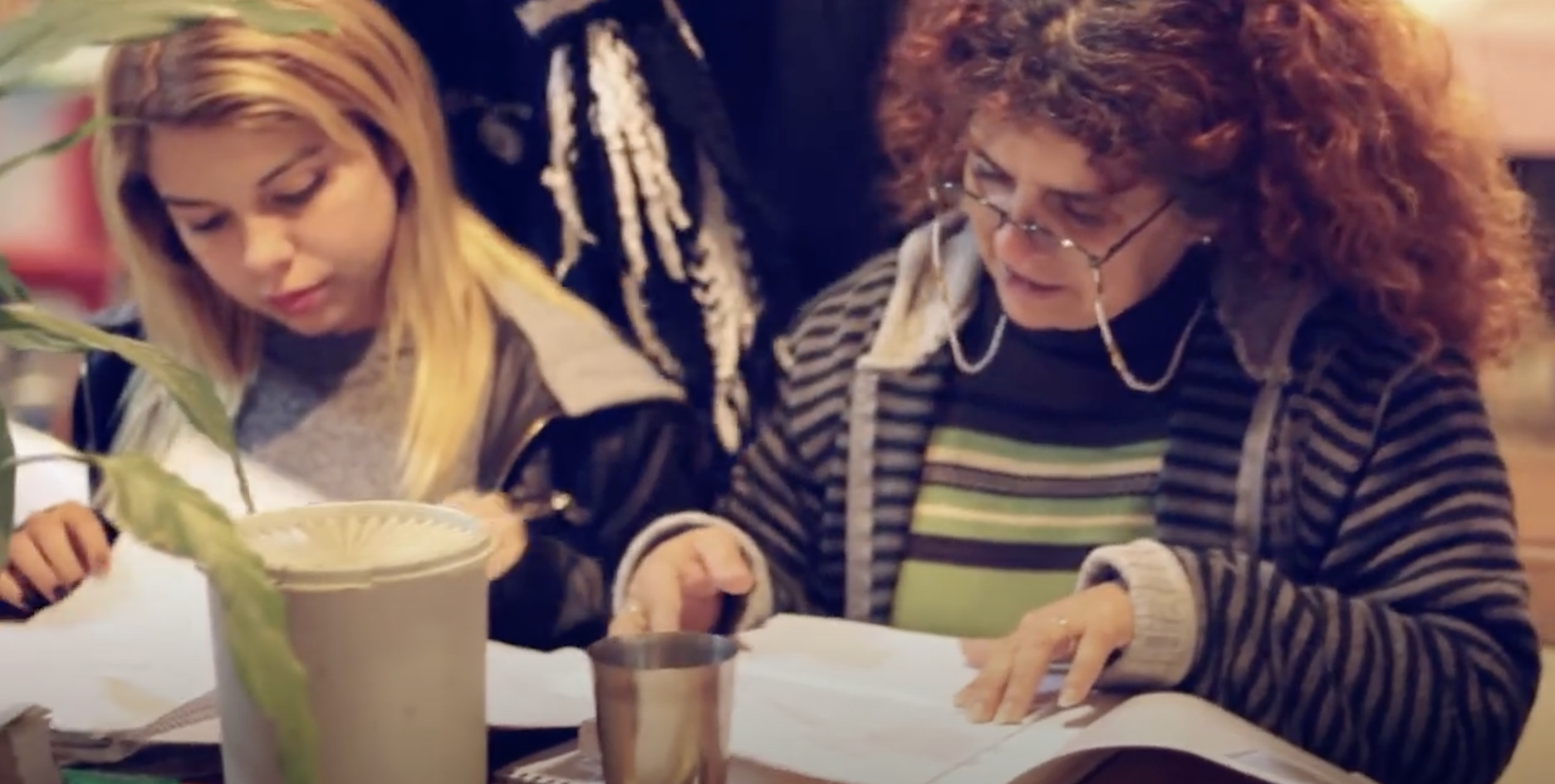
Members of the Villa Inflamable informal settlement community attend a workshop facilitated by ACIJ. On the right-hand side is community leader Claudia Espínola.
Poorvi Chitalkar, Host [00:17:48] But as important as the leadership of individuals like Claudia is, organizing is about building collective power. As organizers, it’s necessary to have a critical mass of community members involved and to keep them interested for a long time. This is not easy.
Catalina Marino, ACIJ [00:18:05] So I think it’s easier to make people like, be involved if they see what they have to gain. If not- if you say someone, “Okay, come here and I discuss with you it like this, and we’ll be fighting for 15 years!” Well, maybe it’s not so easy, right? You will have some participation and you will have some community leaders that will be involved. But they are not- the- like- that’s why they are leaders. Or, that’s why there are some few people that are more willing to be part of those discussions, more strategic discussions, and not so like short term with short benefits. Right?
Poorvi Chitalkar, Host [00:18:46] Keeping a community engaged in processes of change is not easy. Results take time and people are busy. There are costs to participation.
Catalina Marino, ACIJ [00:18:56] Participation is like- we said that people should participate and the community should be like, be involved in every decision. And then, what happens in informal settlements, at least in Argentina, but I think in every informal settlement is that people have jobs and have lives and have- and, yeah- and so you ask them to be like completely involved in their government decisions and so- but for free, because it’s in their interest to be involved and to have a say in what they- in what things are the government doing in their neighborhoods. So, yeah. The community roles now also, not only that you need to organize to get water or to get food or to take the children to school and to work your productive role. But also you need to, like, accomplish your community role. And in that case means to be involving what is happening in your settlement and do something about it. So, yeah, it’s- the cost is high. And maybe if you don’t see the benefit, like, right now then- or maybe you- you’ve been fighting for 15 years, so now you want to rest. And I think that’s kind of. Yeah. Completely fair. There’s no one recipe to solve all problems, right? You have to try like different strategies in different communities. And sometimes you got it right. And sometimes it’s- you don’t.
Poorvi Chitalkar, Host [00:20:31] Two years ago, in 2022, the government made an announcement. Villa Inflamable residents would not be resettled after all.
Catalina Marino, ACIJ [00:20:40] Our goal was for the government to open the spaces and to make the people be really part of the decision. That didn’t happen as we planned it. Like when we started the legal case. They decided that they will develop a slum upgrading program in the settlement, so that people would be- would stay in their homes.
Poorvi Chitalkar, Host [00:21:03] A new slum upgrading program meant that the community would remain in place. No one would be resettled. And this meant that ACIJ’s entire strategy had to change too.
Catalina Marino, ACIJ [00:21:17] The problem with that strategy now is that we face different challenges. So now that we are going to have this slum upgrading program, we want people to participate in that and the design of a plan. But now the challenge that we face is that maybe the community is not mobilized enough because their greatest fear was to be resettled, and now they are going to stay in the settlement. So when we talk about success in these strategies is- I think sometimes we want, like, the whole package and maybe you don’t have that and you need to, I don’t know, think more strategically about your goals. Or maybe, I don’t know, face that maybe not all that you wanted you could have. I think Villa Inflamable example is an interesting example because at that point, at first when we started the case, participation was really crucial for them because not being able to participate mean- like meant to be resettled from their homes, and that was it. And participation seemed to be the way to have a say and to have impact in the decision. When the the resettled option is not longer on the table participation is not like a goal in itself. If community doesn’t think that participation is what they need to do now, if they are okay with the decision of the local government and they want to see what the government’s plans are and not be actively participating after 15 years of fight, then we need to respect that decision and then maybe step back and try to see what are the the demands now. And I think that is essential. If not, you’re imposing like, yeah- like yeah, like a cause that it’s not longer the community cause. I think even if, yeah, what we thought about 15 years ago is not completely what we got, I think that’s a really direct impact of our actions. Apart from that, I’m trying to be positive and optimistic. And in a way, when I see that the local government decision not to resettle Villa Inflamable, is what- that’s the context now, I think we should see that also as a success; that it’s not direct, that it’s not- I cannot be so brave to say, “No, we we did that. Like, this was our work,” because it’s not. it’s part of our work. It’s part of the the whole process. Of course, the local government will try to make it as it was a political decision. And of course it was. But I think that we- with the community mobilization, with the court case, with the litigation, with the demands about participation and information, eventually we made it harder for government to insist on a strategy that the community didn’t want for them to do. So when we said that you should not resettle Villa Inflamable without community participation, eventually they decided not to resettle Villa Inflamable at all. And they say that now it’s because the environmental risk is not as high, whatever. But in a way, they measure what the things were at the moment and the forces that they had to deal with, and I think that the community mobilization was part of the decision of the local government to go on with in-situ upgrading. So that could be a success.
Poorvi Chitalkar, Host [00:25:15] And then in November 2023, Argentina’s political landscape shifted. The right wing populist leader, Javier Milei, was elected as Argentina’s new president.
BBC News, Archival Tape [00:25:28] Javier Milei have been celebrating his victory in the presidential election. Mr. Milei, known as, “El Loco” or the Madman, pulled off a major upset. Provisional results show the self-styled anarcho capitalist won with 55.7% of the vote.
Catalina Marino, ACIJ [00:25:43] Yeah, well the context- the political context is not good for social justice in general. Like the president said a lot, multiple times, that he doesn’t believe in social justice, that social justice is lie. So. Well, we are dealing with that framework.
Javier Milei, President of Argentina (Archival Tape) [00:26:02] De hecho como dice el gran Jesús Huertas de Soto: La justicia social es violenta e injusta. O sea, no es ni justa ni social ni nada, es una aberración. So, as Jesus Huertas de Soto says: Social justice is violence and injust, it’s not just or anything of the sort. Far from it. It’s an aberration.
Poorvi Chitalkar, Host [00:26:27] Remember that slum upgrading program that Catalina talked about earlier? The same program that was responsible for upgrading Villa Inflamable, now that it would not be resettled? That program is financed by the national government, and without national leadership that believes in social justice, it leaves a big question mark around what happens next. The stakes for development in this region are high. Since 2009, the world Bank has been a key investor in the Riachuelo System, something that they’re calling a “mega infrastructure project” on their website. It’s a big investment that will help implement the 2008 Supreme Court ruling and bring improved water and sanitation services for over 4 million people. The total amount that’s being fronted by the World Bank to make this project happen? $1.2 billion. Yes, that’s billion with a B. It’s the World Bank’s biggest investment in Latin America and the Caribbean to date. After the interview, we asked Catalina in an email exchange what she thought about this project. She said that they’re afraid. Afraid that the government’s decision to stop all public investment will translate to a suspension of this project. The success of the project also requires the Argentinean government to do its part. For example, the project may lay down pipes for water and sanitation, but does not always provide home connections. Catalina is worried that once the World Bank’s funded portion of the project ends, the government could decide not to continue their part of the deal – the part that actually makes it possible for households to have access to a connection to the system. And thus, the Riachuelo System, the “mega project” could hit a dead end even before it’s within reach of people’s front doors.
Catalina Marino, ACIJ [00:28:19] On the other hand, it’s not only that we won’t have the resources. That’s in itself, it’s a lot. But also, we are dealing with a public discourse that is not open to hear claims that are framed in the rights-based language. We will not be able to convince any government official that people have rights to do something, because they are not like- they don’t see reality through that lens. So, yeah, it’s- it’s not a good time.
Poorvi Chitalkar, Host [00:28:54] So what do you do? What do you do when you’ve spent so long giving social justice a concrete shape? On the one hand, building power in communities, and on the other hand, convincing the government that listening to community voices leads to better decisions. And after all that, the institutions completely abandoned the language of social justice. One thing about Catalina and her colleagues at ACIJ is that they don’t sit around and wait to see what happens next. Her team at ACIJ is trying to learn- learn from others who might have their own experiences with closing democratic spaces, and can teach them lessons on how to navigate this moment. The Grassroots Justice Network has become that critical space for learning.
Catalina Marino, ACIJ [00:29:37] We were better off than other countries or other communities are to fight for our rights. And the communities were like- they have this minimum of rights being respected. I think that now, what I want to understand is how you could develop community mobilization in other contexts, like, when democracy is not given, right? Or when retaliation could be more violent. Not to say that we are going in that direction, because I don’t think that’s where we are going. But what I think is we are now dealing with a political context that is not, again, open to some legal rights discourses or language. And so I think we should learn from others and how to deal with that set of challenges. I don’t know, I think for me that will be promising.
Poorvi Chitalkar, Host [00:30:37] There is no recipe, like Catalina says. There is no one strategy that will guarantee community participation, but there are guiding values and principles that inform ACIJ and their work, that help them shift and readjust their strategy as the tide changes.
Catalina Marino, ACIJ [00:30:53] Participation is one of the core values, right? We we are really convinced that in order to have like social urban justice, we need community participation and engagement, not only because it’s the right thing to do, but also because it is in the best interest of local governments and public policy is better when reflect what community needs and desires are also. So of course, participation is a center of our actions, but I think that what guides most of our strategies is, in a way, trying to understand what the community needs or what the community wants at some point.
Poorvi Chitalkar, Host [00:31:48] The future of Villa 21-24 and Villa Inflamable is unknown. But there is one thing we know: as long as there are the Claudia’s of the world, community members who know, use and shape the law, community power will continue to grow. The fight may take years, but ultimately community members will shape their own destiny. And so the dance goes on. [MUSIC]
Poorvi Chitalkar, Host [00:32:20] We named this podcast “A Common Pot,” because we wanted to explore recipes for social justice and systems change from around the world. Talking to Catalina, it’s clear that when it comes to community participation, there is no one recipe. Instead, you need to find different strategies for different contexts. Well, maybe that’s the case, but what about actual recipes? We also ask Catalina what her favorite recipe is to cook.
Catalina Marino, ACIJ [00:32:45] So we have a grill in the balcony. That’s the most Argentinian that you could get. Like a grill in the balcony, like in the building.
Poorvi Chitalkar, Host [00:32:53] I love that.
Catalina Marino, ACIJ [00:32:54] My neighbor from, upstairs, they won’t be fun about the grill in the balcony, I think.
Poorvi Chitalkar, Host [00:33:04] This episode was produced by me, Poorvi Chitalkar. Our managing producer is Jackie Sofia. Audio engineering and sound design by Mohamad Khreizat. Editorial support by Marta Almela Menjón, Maria Atuesta and the Namati Communications team. Additional support by Anuradha Joshi. And a very special thanks to Catalina Marino and ACIJ for sharing their story. “A Common Pot: Stories of Grassroots Justice,” is a production of Namati and the Grassroots Justice Network. To join the network, head to GrassrootsJusticeNetwork [dot] org and follow us on social media on YouTube, X formerly Twitter and Facebook at GrassrootsJN.
[“A Common Pot” Outro Sting]
EPISODIO 1, ACIJ – “EL BAILE”
TRANSCRIPCIÓN DEL EPISODIO COMPLETO
[Sintonía de entrada de A Common Pot]
Poorvi Chitalkar, presentadora [00:00:07] Esto es A Common Pot (‘Puchero común’), un podcast en el que exploramos historias y recetas para la justicia social y la transformación de sistemas de todo el mundo.
Poorvi Chitalkar, presentadora [00:00:31] ¿Qué harías si viniera alguien a decirte cómo proteger tu salud y tu bienestar sin siquiera hablar contigo? Si estuvieras exigiendo un entorno limpio y la respuesta del gobierno fuera obligarte a abandonar tu casa, ¿qué harías? Esto es lo que pasó en la cuenca del río Matanza-Riachuelo en Argentina, uno de los ríos más contaminados de Latinoamérica. En 2010 unas 63.000 personas que vivían en uno de los tramos de la cuenca de este río recibieron la noticia de que iban a ser relocalizados. Para muchos de ellos fue una sorpresa enterarse de ello cuando se publicó en el periódico local. Tan solo dos años antes, en 2008, estas mismas comunidades habían ganado un importante proceso judicial en la Corte Suprema de Argentina. El fallo de la corte señalaba que los efectos de la contaminación en sus comunidades junto a la cuenca del río, provocados por las grandes corporaciones en la zona, debían ser solucionados. La corte ordenó que la zona debía ser limpiada y que se debían evitar daños en el futuro. Una cosa era el fallo judicial, cómo se implementaría, pero otra cosa completamente distinta era cómo se implicaría a las comunidades afectadas. El hecho de que la corte hubiera dictaminado un fallo tan importante no implica necesariamente que se implementara de la manera más beneficiosa para las comunidades afectadas. Y de pronto en 2010, dos años después de la orden de la Corte Suprema, aquellos que debían ser los principales beneficiarios de la misma iban a ser desplazados. Esto nos plantea una pregunta que se repetirá mucho en todo este podcast. ¿Cómo mantiene una comunidad su derecho a decidir sobre su propio destino? Sobre todo, cuando se están tomando decisiones sin tener en cuenta su opinión. En el episodio de hoy, el primero del podcast, compartimos la historia de la organización por la justicia de base ACIJ (Asociación Civil por la Igualdad y la Justicia) y su labor por generar y fortalecer la participación comunitaria en dos asentamientos informales en Argentina: Villa 21-24 y Villa Inflamable.
Poorvi Chitalkar, presentadora [00:02:43] Esta es la historia del trabajo real que tiene lugar después de una gran victoria.
Catalina Marino, ACIJ [00:02:56] Hola. Poorvi! Vaya, ya la hemos liado nada más empezar. [Se ríe]
Poorvi Chitalkar, presentadora [00:03:01] Esta es Catalina.
Catalina Marino, ACIJ [00:03:02] Soy Catalina Marino. Trabajo en ACIJ, la Asociación Civil por la Igualdad y la Justicia. ACIJ es una organización sin ánimo de lucro que se dedica a defender los derechos de los grupos más desfavorecidos de la sociedad y a fortalecer la democracia en Argentina.
Poorvi Chitalkar, presentadora [00:03:22] Uno de los grupos más desfavorecidos en Argentina son las personas que viven en los asentamientos informales. ACIJ ha trabajado con las comunidades de los asentamientos informales de Argentina más de 20 años. Su trabajo en la cuenca del río Matanza-Riachuelo comenzó en 2011.
Catalina Marino, ACIJ [00:03:37] La cuenca de este río es una zona muy grande en Argentina, incluye la ciudad de Buenos Aires y otros 14 municipios de la provincia de Buenos Aires.
Poorvi Chitalkar, presentadora [00:03:47] De acuerdo con el Banco Mundial, se estima que un 10% de la población de Argentina vive dentro de los 2.000 km² de la cuenca. Eso supone unos 4 millones de personas.
Catalina Marino, ACIJ [00:03:57] Dentro de esta zona tenemos unos 1.600 asentamientos informales. Pero de nuevo, se trata de una zona muy, muy grande. Algunos de estos asentamientos están cerca del río o muy cerca, porque la cuenca es verdaderamente grande, y luego tienes una pequeña parte que está pegada al río. Para que quede claro, no es lo mismo vivir en la cuenca del río que vivir junto al río. De acuerdo con lo que dicen los residentes, hace dos décadas podías oler y ver realmente la contaminación en el río y olerla todos los días, sobre todo porque dentro de estas zonas había muchas industrias que solían verter sus desechos al agua.
Poorvi Chitalkar, presentadora [00:04:50] Las dos comunidades de las que hablaremos hoy son Villa Inflamable y Villa 21-24. Villa Inflamable se encuentra justo en el extremo sudoriental de la ciudad de Buenos Aires. Justo al lado se encuentran los complejos petroquímicos más grandes del país. Un poco más hacia el interior desde la desembocadura del río se encuentra Villa 21-24.
Catalina Marino, ACIJ [00:05:16] Villa Inflamable se llama así porque hubo un incendio junto al río y al puerto, hace muchas décadas y se quedaron con el nombre. El nombre tiene un poco una connotación negativa para algunos de los residentes porque les asocia a la contaminación.
Poorvi Chitalkar, presentadora [00:05:38] Durante muchos años los vecinos del asentamiento informal de Villa Inflamable enfermaban constantemente. Y no estamos hablando de una gripe o un resfriado. Estamos hablando de problemas de salud serios y a veces irreversibles.
Catalina Marino, ACIJ [00:05:49] Dentro del centro de salud comenzaron a detectar altos niveles de tolueno y plomo en la sangre.
Poorvi Chitalkar, presentadora [00:05:56] El plomo es un metal pesado tóxico. Los expertos médicos y de salud pública están de acuerdo en que no hay nivel de plomo en el cuerpo humano que sea seguro. Puede provocar serios problemas de salud, especialmente en niños y mujeres embarazadas. Puede tener efectos irreversibles en el sistema neurológico. Una vez que se ha producido el daño es irreparable. En 2004 una mujer llamada Beatriz Mendoza comenzó a tomar nota de estos efectos mientras trabajaba en Villa Inflamable.
Catalina Marino, ACIJ [00:06:24] Era trabajadora social y trabajaba en el centro de salud de Villa Inflamable. Beatriz Mendoza fue la que lideró a un grupo de vecinos en 2004 que presentaron una querella contra el gobierno nacional y la provincia de Buenos Aires y contra la ciudad de Buenos Aires y 44 empresas, quejándose de los daños que sufría la población como resultado de la contaminación de la cuenca del río Matanza-Riachuelo. Así es como comenzó este litigio.
Dr. Andrés Napoli, CELS-FARN-Greenpeace (Grabación de archivo) [00:06:58] El daño ambiental colectivo producido tiene claros y directos responsables, las autoridades y las industrias y actividades de servicios, sí señor.
Catalina Marino, ACIJ [00:07:05] Sí, fue el primer juicio colectivo por contaminación que tuvimos en el país.
Dr. Jorge Mosset Iturraspe en la corte Suprema Argentina, representante del demandante (grabación de archivo) [00:07:13] La contaminación es, sin lugar a dudas, un hecho público y notorio, como lo es también sin hesitaciones la responsabilidad de los estados.
Catalina Marino, ACIJ [00:07:25] En 2008, la Corte Suprema de Justicia emitió un falló histórico que declaraba que el estado y los distintos gobiernos eran responsables de llevar a cabo acciones sanitarias en la cuenca del río.
Poorvi Chitalkar, presentadora [00:07:38] El fallo final de la corte decía tres cosas: la calidad de vida tenía que mejorar para la gente que vivía alrededor de la cuenca del río, se debía limpiar y recuperar el medio ambiente y se debían evitar daños en el futuro.
Catalina Marino, ACIJ [00:07:50] Sí, fue un fallo histórico porque era como dar a entender que diferentes niveles del estado eran responsables de proteger el medio ambiente y a los residentes.
Poorvi Chitalkar, presentadora [00:08:02] En 2010, dos años después de que la corte emitiera su fallo, la gente de Villa Inflamable se enteró por los periódicos de que iban a ser desplazados.
Catalina Marino, ACIJ [00:08:12] Los gobiernos no habían establecido ningún tipo de estructura o plan para hacer esta decisión participativa. Así que lo que comenzó a suceder, especialmente en Villa Inflamable, es que la información nunca venía de fuentes oficiales… Los funcionarios del gobierno nunca se acercaron a la población para decirles que iban a ser relocalizados. La gente se enteró de que iba a ser desplazada por los periódicos. Había una especie de acuerdo que decía que todas las familias que vivían junto al río serían reubicadas, desplazadas de sus hogares por la contaminación.
Poorvi Chitalkar, presentadora [00:08:56] Las comunidades, cuya salud y bienestar ya estaba enormemente comprometido por la contaminación de la zona, tenían además que cambiar drásticamente su vida y sin poder opinar sobre el asunto. De los dos asentamientos, Villa Inflamable era el que se enfrentaba a la reubicación de toda la comunidad. ACIJ junto a líderes comunitarios y los residentes intentaron razonar con los funcionarios del gobierno local sobre el caso de Villa Inflamable. Intentaron convencerles de que la comunidad tenía derecho a ser informada sobre la reubicación con tiempo y que se debería tener en cuenta su opinión en cualquier decisión que se tomara en el futuro. También intentaron explicar que esto sería beneficioso para el gobierno porque evitaría complicaciones con el posterior reasentamiento. Pero el gobierno no estuvo de acuerdo. Así que la ACIJ tomó acciones contra el gobierno local.
Catalina Marino, ACIJ [00:09:50] Así que finalmente lo que hicimos fue presentar una demanda.
Poorvi Chitalkar, presentadora [00:09:55] Otra demanda. Sí.
Catalina Marino, ACIJ [00:09:56] Para decir que la gente en Inflamable tenía derecho a comprender plenamente lo que estaba sucediendo, a tener información completa sobre los planes de su gobierno y a tener un espacio donde pudieran debatir, tener voz e incluso voto junto al gobierno sobre los pasos a tomar. Y ganamos el caso. Y eventualmente salió el fallo que dijo que la gente de Inflamable tenía derecho a tener información y a participar en el proceso. Y eso fue realmente una gran victoria. Y también tenemos muchas buenas prácticas, documentos, documentos formales, que nos permiten en cierto modo exigirle al gobierno que cumpla con estas demandas de participación e información.
Poorvi Chitalkar, presentadora [00:10:45] Y lo creáis o no, aquí es donde comenzó el verdadero reto. Presentar una demanda y ganarla fue algo grande, pero también supuso que la ACIJ tenía que encontrar ahora una manera de asegurarse de que todos los involucrados tuvieran clara la participación comunitaria. Surgieron dos grandes retos. En primer lugar, estaba el reto de cómo organizar a las comunidades para que pudieran aprovechar esta victoria, consolidar lo ganado y construir una especie de masa crítica para impulsar las cosas. En segundo lugar, también estaba el reto de cómo hacer que conocieran y utilizaran la ley y pudieran defender sus necesidades y derechos durante el proceso de reasentamiento, pero también en un futuro más lejano para que esto no se quedara en algo puntual, sino que el conocimiento quedara incorporado a las comunidades.
Catalina Marino, ACIJ [00:11:34] La Villa 21-24 ya estaba más organizada. Había muchas organizaciones trabajando ahí. Pero en cierto modo, lo que sucedió fue que desde el principio estuvieron muy bien asesorados. La defensa pública, los abogados que les prestaron asesoramiento jurídico gratuito por parte del estado, trabajaban ya ahí, así que les ayudaron a convertirse en un gran grupo, a pensar más en el colectivo y no en los problemas individuales. ¿No? Y eligieron delegados, como líderes de diferentes bloques, porque los asentamientos están compuestos de diferentes bloques. Así que eligieron representantes dentro de cada bloque. Y estos líderes se convirtieron en el Cuerpo de Delegados, como los líderes comunitarios de la cuenca del río.
Poorvi Chitalkar, presentadora [00:12:30] El nivel de organización fue impresionante, por no decir otra cosa. Estamos hablando de una población enorme. Más de 2.000 familias en Villa 21-24 se vieron afectadas por el fallo del tribunal. Los líderes comunitarios de Villa 21-24 incluso lograron identificar temas importantes para ciertas secciones o bloques de la comunidad y comenzaron a generar estrategias alrededor de esos temas, por ejemplo…
Catalina Marino, ACIJ [00:12:53] En un primer lugar decidieron que había un bloque en concreto que tenían muchos problemas de salud. Y decidieron que la primera solución con sus casas… Que cualquier intervención que hiciera el gobierno tenía que empezar por ese bloque en concreto. Incluso decidieron qué se haría primero en las decisiones digamos del gobierno. Así que comenzaron a reunirse y a discutir cual sería la mejor estrategia. Y tenían también sus consejeros en un primer momento y creo que eso es algo realmente potente para construir comunidad por decirlo así. Entendieron cuáles eran los objetivos e incluso decidieron lo que era más relevante para ellos.
Poorvi Chitalkar, presentadora [00:13:47] Hay que recordar que estamos hablando de dos comunidades diferentes. Hasta ahora hemos estado hablando de Villa 21-24, donde solo había una parte de la población que se enfrentaba al reasentamiento, pero Villa Inflamable era una comunidad mucho más grande y su situación era distinta.
Catalina Marino, ACIJ [00:14:02] El caso de Villa Inflamable era terrible porque ellos…
Poorvi Chitalkar, Host [00:14:05] “Ellos” es el gobierno.
Catalina Marino, ACIJ [00:14:07] …ellos habían decidido que todo el asentamiento tenía que ser reubicado. Así que realmente era un proceso de reasentamiento enorme.
Poorvi Chitalkar, presentadora [00:14:13] Villa Inflamable necesitaba más apoyo. Así que ACIJ trabajó con la comunidad para ayudar a solventar las carencias. Organizaron talleres y cursos de empoderamiento legal para ayudar a la comunidad a comprender sus derechos legales y a utilizar la ley para exigir sus derechos.
Taller de participación comunitaria de ACIJ (grabación de archivo) [00:14:33] Para aquellos que las armaron. Claro ¿y al lado de la Constitución que había?
Catalina Marino, ACIJ [00:14:35] Hablamos con mucha gente en Villa Inflamable sobre las cosas que podían reclamar. ¿No? Por supuesto uno de los temas fue la participación y la información. Y también tener algo que decir en las decisiones del gobierno.
Poorvi Chitalkar, presentadora [00:14:49] Y recabaron información. Mucha, mucha información.
Catalina Marino, ACIJ [00:14:53] La gente en Villa Inflamable no tenía agua. Tenía un problema con el agua contaminada, porque el suelo estaba contaminado. Así que había mucho… En un principio era un gran problema. Por supuesto que no tenían carreteras, carreteras asfaltadas. No tenían servicios formales por supuesto. Y como tenían que ser relocalizados, el gobierno no quería invertir en infraestructuras. Así que lo que hicimos fue comprender cuál era el problema, teníamos nuestra propia información que generamos con el barrio. Y esa fue una herramienta realmente poderosa para hacer que el gobierno, por lo menos, fuera consciente de la situación que estaban enfrentando las comunidades. ¿No?
Poorvi Chitalkar, presentadora [00:15:37] A través de encuestas y reuniones comunitarias periódicas en Villa Inflamable, ACIJ trabajó duro para implicar a la comunidad para que documentara y comprendiera mejor su propio caso. Fue un baile constante en dos niveles. En un nivel, ACIJ estaba trabajando para convencer al gobierno de que proporcionara espacios para una participación significativa. En otro nivel estaban trabajando para equipar a las comunidades del asentamiento informal con las herramientas y la información que necesitaban para comprender sus derechos y expresar sus demandas en el lenguaje de los derechos. Y el lenguaje es importante. Muchas veces las comunidades marginalizadas se enfrentan al problema de que no hablan con fluidez el lenguaje del derecho. Lograr esta fluidez lleva tiempo. Lleva años de estudio comprender algo que es complicado por naturaleza. Pero una mujer de Villa Inflamable pareció entender el lenguaje. Su nombre es Claudia Espínola.
Catalina Marino, ACIJ [00:16:30] ¿Cómo sé que la participación ha funcionado? En lo primero que pienso es en Claudia.
Poorvi Chitalkar, presentadora [00:16:37] Si haces una búsqueda en YouTube, encontrarás a Claudia haciendo que se escuche su voz frente a la cámara. Tiene confianza. Su pelo largo y rizado tiene un tono rojizo y hay una llama en su espíritu que sale a la luz cuando habla de las necesidades de su comunidad.
Claudia Espínola, líder comunitario de Villa Inflamable (grabación de archivo) [00:16:53] En esas audiencias se supone que tenemos que estar nosotros. ¿Quién era nuestra voz? ¿Quiénes nos representaban en todo caso? Saber eso en el 2015.
Catalina Marino, ACIJ [00:17:02] Tiene ese discurso de derechos legales realmente internalizado en su forma de hablar. Y creo que esa forma de expresar y también de enmarcar las demandas es completamente necesaria para… Te da más fuerza cuando discutes con gobiernos o con jueces o con otros funcionarios públicos. Cuando ves lo que hace ahora en el barrio, comprendes que ha estado luchando por su barrio por más de 15 años. Y que todo lo que hace… Es una lideresa comunitaria y desarrolla muchas estrategias para luchar con los problemas diarios del asentamiento.
Poorvi Chitalkar, presentadora [00:17:48] Pero por muy importante que sea el liderazgo de personas como Claudia, organizar va de construir poder colectivo. Como organizadores es necesario tener una masa crítica de miembros de la comunidad implicados y mantener su interés en el largo plazo. Esto no es fácil.
Catalina Marino, ACIJ [00:18:05] Creo que es más fácil hacer que la gente se implique si ve lo que tienen que ganar. Si no… Si le dices a alguien “Vale, ven aquí y hablemos de esto y vamos a estar peleando por 15 años” Bueno, quizás no es tan sencillo, ¿no? Tendrás algo de participación y tendrás algunos líderes comunitarios que se implicarán. Pero no son… Esa es la razón por la que son líderes. O por eso es por lo que hay algunos pocos que están más dispuestos a formar parte de esas discusiones, de discusiones más estratégicas y no de discusiones a corto plazo con pequeños beneficios. ¿No?
Poorvi Chitalkar, presentadora [00:18:46] Mantener una comunidad implicada en los procesos de cambio no es fácil. Los resultados llevan tiempo y la gente está ocupada. La participación tiene su coste.
Catalina Marino, ACIJ [00:18:56] La participación es como… Nosotras decíamos que la gente debería participar y la comunidad debería implicarse en todas las decisiones, pero luego lo que pasa en los asentamientos informales, al menos en Argentina, aunque creo que, en realidad en cualquier asentamiento informal, es que la gente tiene su trabajo y su vida, así que pedirles que se impliquen completamente en las decisiones de su gobierno y eso… y además gratis, porque es en su propio interés que se impliquen y tener voz y voto en lo que… En las cosas que hace el gobierno en sus barrios. Vamos que sí. Ahora también tu papel en la comunidad, no solo tienes que organizarte y conseguir agua o comida o llevar a los niños a la escuela y trabajar, tu papel productivo, sino que también tienes que cumplir con tu papel en la comunidad. Y en este caso significa estar implicando lo que sucede en tu asentamiento y hacer algo al respecto. Así que sí, el coste es muy alto. Y quizás si no ves los beneficios, digamos de forma inmediata… O puede que hayas estado luchando durante 15 años y ahora lo que quieres es descansar. Y creo que eso es, en cierto modo, completamente justo. No hay una sola receta para solucionar todos los problemas, ¿no? Tienes que intentar diferentes estrategias en diferentes comunidades. Y a veces lo haces bien. Y otras no.
Poorvi Chitalkar, presentadora [00:20:31] Hace dos años, en 2022, el gobierno hizo un anuncio. Los residentes de Villa Inflamable no serían relocalizados después de todo.
Catalina Marino, ACIJ [00:20:40] Nuestro objetivo era que el gobierno abriera los espacios y hacer que la gente participara realmente en la toma de decisiones. Pero las cosas no fueron como teníamos planeado cuando empezamos con el caso legal. Decidieron que desarrollarían un programa de mejora del barrio en el asentamiento para que la gente pudiera, digamos, quedarse en sus casas.
Poorvi Chitalkar, presentadora [00:21:03] Un nuevo programa de mejora del barrio suponía que la comunidad se mantendría en el lugar. No se relocalizaría a nadie. Y esto significaba que toda la estrategia de ACIJ tenía que cambiar también.
Catalina Marino, ACIJ [00:21:17] El problema con esa estrategia ahora es que nos enfrentamos a retos distintos. Así que ahora que vamos a tener este programa de mejora del barrio, queremos que la gente participe en el mismo y en el diseño del plan. Pero ahora el reto al que nos enfrentamos es que quizás la comunidad no está lo suficientemente movilizada porque su mayor miedo era ser relocalizados y ahora saben que se van a quedar en el asentamiento. Así que cuando hablamos de éxito en estas estrategias… A veces pienso que queremos todo el paquete y que quizás no lo logras y tienes que pensar, no sé, de forma más estratégica sobre tus objetivos. O quizás, no sé, enfrentarse a la idea de que quizás no puedas lograr todo lo que quieres. Creo que el ejemplo de Villa Inflamable es un ejemplo interesante porque en ese momento, al principio, cuando comenzamos con el caso, la participación era realmente crucial para ellos, porque no ser capaces de participar significaba que serían sacados de sus casas y ya está. Y la participación parecía ser una manera de tener voz y voto y de tener un impacto sobre la decisión. Cuando posteriormente la opción de la relocalización ya no estaba sobre la mesa, la participación ya no se convierte en un objetivo en sí mismo. Si la comunidad no piensa que la participación es lo que tiene que hacer en ese momento, si están contentos con la decisión del gobierno local y quieren ver lo que van a ser los planes del gobierno y no participar de forma activa después de 15 años de lucha, entonces tenemos que respetar esa decisión y quizás dar un paso atrás e intentar ver cuáles son las demandas actuales. Y creo que eso es esencial. Si no estás imponiendo una causa que ya no es la causa de la comunidad. Incluso si no hemos logrado del todo lo que pensamos hace unos 15 años, creo que sigue siendo un impacto directo real de nuestras acciones. Aparte de eso intento ser optimista y positiva. Y en cierto modo, cuando veo que la decisión del gobierno local de no relocalizar Villa Inflamable es que… Ese es el contexto ahora. Creo que deberíamos ver que eso también es un éxito, un éxito que no es directo, que no es… No puedo atreverme a decir “No, nosotros hicimos eso. Esto ha sido obra nuestra”, porque no lo es. Es parte de nuestro trabajo. Es parte de todo el proceso. Por supuesto el gobierno local intentará hacer ver que ha sido una decisión política. Y por supuesto que lo fue. Pero creo que nosotros, con la movilización de la comunidad, con el caso judicial, con la litigación, con las demandas de participación e información, eventualmente logramos que fuera más difícil para el gobierno insistir en una estrategia que la comunidad no quería para ellos. Así que cuando dijimos que no se debía relocalizar Villa Inflamable sin la participación de la comunidad, finalmente acabaron decidiendo no relocalizar Villa Inflamable en absoluto. Ahora dicen que es porque el riesgo medioambiental no es tan alto o lo que sea, pero en cierto modo, valoraron como eran las cosas en su momento y las fuerzas con las que tuvieron que lidiar y creo que la movilización de la comunidad fue parte de la decisión del gobierno local de optar por una mejora in-situ. Así que podría considerarse un éxito.
Poorvi Chitalkar, presentadora [00:25:15] Y después en noviembre de 2023, cambió todo el panorama político de Argentina. El líder de derecha populista Javier Milei fue elegido presidente de Argentina.
BBC News, grabación de archivo [00:25:28] Javier Milei ha celebrado su victoria en las elecciones presidenciales. Milei, conocido como “el loco” ha dado la sorpresa. Los resultados provisionales muestran que el autodenominado anarcocapitalista ganó con el 55,7% de los votos.
Catalina Marino, ACIJ [00:25:43] Sí, bueno el contexto político no es bueno para la justicia social en general. El presidente ha dicho ya muchas veces que no cree en la justicia social, que la justicia social es una mentira. Así que, bueno ese es el marco con el que estamos lidiando.
Javier Milei, presidente de Argentina (grabación de archivo) [00:26:02] De hecho como dice el gran Jesús Huertas de Soto: La justicia social es violenta e injusta. O sea, no es ni justa ni social ni nada, es una aberración. So, as Jesus Huertas de Soto says: Social justice is violence and injust, it’s not just or anything of the sort. Far from it. It’s an aberration.
Poorvi Chitalkar, presentadora [00:26:27] ¿Os acordáis de ese programa de mejora del barrio del que hablaba antes Catalina? ¿El mismo programa que era responsable de la mejora de Villa Inflamable, ahora que no va a ser relocalizada? Ese programa está financiado por el gobierno nacional y sin un liderazgo nacional que crea en la justicia social, lo que vaya a pasar a partir de ahora queda en el aire. Hay mucho en juego en esta región. Desde 2009 el Banco Mundial ha sido uno de los principales inversores en el sistema Riachuelo, algo que en su página web llaman una “mega obra de infraestructura”. Es una gran inversión que ayudará a implementar el fallo de la Corte Suprema de 2008 y traer mejores servicios de agua y saneamiento para más de 4 millones de personas. La cantidad total adelantada ya por el Banco Mundial para que este proyecto se haga realidad es de 1.200 millones de dólares. Sí, estamos hablando de miles de millones. Es la mayor inversión del Banco Mundial en Latinoamérica y el Caribe hasta la fecha. Después de la entrevista le preguntamos a Catalina por correo electrónico lo que pensaba de este proyecto. Respondió que estaban asustados. Asustados de que la decisión del gobierno de detener toda la inversión pública se trasladara a la suspensión de este proyecto. El éxito de este proyecto también requiere que el gobierno argentino cumpla con su parte. Por ejemplo, el proyecto podría instalar tuberías para el agua y el saneamiento, pero no siempre proporciona conexiones a los hogares. Catalina está preocupada de que una vez que termine la parte del proyecto financiada por el Banco Mundial, el gobierno pueda decidir no continuar con su parte del trato, la parte que hace que realmente los hogares puedan tener acceso a una conexión al sistema. Y de esta manera el sistema Riachuelo, la “mega obra”, podría llegar a un callejón sin salida antes incluso de llegar a la puerta de la gente.
Catalina Marino, ACIJ [00:28:19] Por otro lado, no es solo que no tendremos los recursos, algo que ya de por sí es importante, sino que además nos enfrentamos a un discurso público que no está dispuesto a escuchar reclamaciones enmarcadas en un lenguaje basado en los derechos humanos. No seremos capaces de convencer a ningún funcionario del gobierno de que la gente tiene derecho a hacer algo, porque no son… No ven la realidad a través de esa lente. Así que sí, no es una buena época.
Poorvi Chitalkar, presentadora [00:28:54] ¿Entonces que hacer? ¿Qué hacer cuando después de pasar tanto tiempo dándole forma a la justicia social? Generando por un lado poder en las comunidades y por el otro convenciendo al gobierno de que escuchar la voz de las comunidades lleva a la toma de mejores decisiones. Para que después de todo eso, las instituciones abandonen completamente el lenguaje de la justicia social. Algo que define a Catalina y sus colegas de la ACIJ es que no se quedan sentados esperando a ver qué es lo que pasa. Su equipo en la ACIJ está intentando aprender, aprender de otros que pueden tener sus propias experiencias con espacios democráticos menguantes y que pueden enseñarles lecciones sobre cómo navegar este momento. La Grassroots Justice Network se ha convertido en ese espacio crítico de aprendizaje.
Catalina Marino, ACIJ [00:29:37] Estábamos en una situación mejor que la de otros países y otras comunidades para luchar por nuestros derechos. Se respetaban por lo menos unos mínimos derechos de las comunidades. Creo que ahora lo que quiero entender es cómo se puede desarrollar la movilización comunitaria en otros contextos, como un contexto en el que la democracia ya no se dé por hecho, ¿no? O cuando la represión pueda ser más violenta. No digo que vayamos en esa dirección, porque no creo que vayamos en esa dirección. Pero lo que creo es que estamos enfrentándonos a un contexto político que, de nuevo, no está abierto a ciertos discursos o lenguaje de los derechos humanos. Por eso pienso que deberíamos aprender de otros sobre cómo actuar con ese conjunto de retos. No sé, creo que para mí eso es prometedor.
Poorvi Chitalkar, presentadora [00:30:37] No existe una receta, como dice Catalina. No hay solo una estrategia que garantice la participación comunitaria, pero hay valores y principios guía que conforman su trabajo, que les ayudan a cambiar y reajustar su estrategia a medida que cambia la marea.
Catalina Marino, ACIJ [00:30:53] La participación es uno de los valores centrales, ¿no? Estamos realmente convencidos de que para que haya justicia social urbana, necesitamos la participación y la implicación de la comunidad… No solo porque es lo correcto, sino porque es en el mejor interés de los gobiernos locales y las políticas públicas son mejores cuando reflejan las necesidades y deseos de la comunidad. Así que, por supuesto la participación está en el centro de nuestras acciones, pero creo que lo que guía la mayoría de nuestras estrategias es, en cierto modo, el intento de comprender qué es lo que necesita la comunidad o qué es lo que quiere en un momento dado.
Poorvi Chitalkar, presentadora [00:31:48] El futuro de Villa 21-24 y de Villa Inflamable es una incógnita. Pero hay algo que sí sabemos: mientras haya Claudias, miembros de la comunidad que conocen, utilizan y dan forma al derecho, el poder de la comunidad seguirá creciendo. La lucha puede que dure años, pero en última instancia los miembros de la comunidad darán forma a su propio destino. Y así sigue el baile. [MÚSICA]
Poorvi Chitalkar, presentadora [00:32:20] Hemos llamado este podcast A Common Pot porque queríamos explorar recetas para la justicia social y el cambio de sistemas de todo el mundo. Hablando con Catalina queda claro que cuando hablamos de la participación comunitaria no existe una sola receta. Por el contrario, es necesario encontrar diferentes estrategias para diferentes contextos. Bueno, quizás ese es el caso, pero ¿qué pasa con las recetas de verdad? También le preguntamos a Catalina por su receta preferida en la cocina.
Catalina Marino, ACIJ [00:32:45] Pues tenemos una parrilla en el balcón. Es de lo más argentino que te puedes encontrar. Una parrilla en el balcón, en el edificio.
Poorvi Chitalkar, presentadora [00:32:53] Me encanta.
Catalina Marino, ACIJ [00:32:54] Mis vecinos de arriba creo que no están muy contentos con la parrilla en el balcón.
Poorvi Chitalkar, presentadora [00:33:04] Este episodio ha sido producido por mí, Poorvi Chitalkar. Nuestra directora de producción es Jackie Sofia. La dirección y el diseño de sonido ha sido realizado por Mohamad Khreizat. El apoyo editorial ha corrido a cuenta de Marta Almela Menjón, María Atuesta y el equipo de comunicación de Namati. También hemos tenido el apoyo de Anuradha Joshi. Especiales gracias a Catalina Marino y a la ACIJ por compartir su historia. A Common Pot: Stories of Grassroots Justice, es una producción de Namati y Grassroots Justice Network. Si te quieres unir a la red puedes ir a GrassrootsJusticeNetwork [punto] org y puedes seguirnos en nuestras redes sociales YouTube, X anteriormente Twitter y Facebook en GrassrootsJN.
[Melodía de cierre de A Common Pot]
As Mozambique’s economy grows, it is more important than ever to support communities to delimit their lands and take empowered action to enter into negotiations with potential investors. Yet since the passage of the Lei de Terra in 1997, only a few hundred communities across Mozambique have been delimited. Starting in 2009, Namati and CTV investigated how to facilitate community land delimitation processes more efficiently. Our findings identified a potentially high-impact solution: by teaching communities to undertake the delimitation process on their own – led by trained local paralegals and supervised by a legal and technical field team – government actors and land rights advocates can support the delimitation efforts of many more communities. This low-cost and community-driven approach allows one regional technical team to support and supervise multiple communities’ efforts simultaneously, opening the door for community land delimitation at scale.
Based on this finding, CTV and Namati now employ dozens of locally-based paralegals to lead communities through the delimitation process. These trained and supervised paralegals, or ‘Community Mobilizers,’ convene and facilitate community meetings, answer questions about land tenure rights in Mozambique, and support their communities to complete each aspect of the delimitation process.
The study described in this report provides crucial insight into how to improve NGO and government facilitation of community land delimitation processes. The data clearly indicate that delimitation efforts that end merely with a certificate and a map may do an injustice to communities; it is necessary to go beyond technical delimitation to ensure that communities have the tools to create, plan for and actualize their own vision of a prosperous future. It is critical to frame community land delimitation efforts as a comprehensive package of work that combines mapping and delimitation with improving governance and safeguarding the land rights of women and other vulnerable groups. To ensure that community members are equipped to enter into authentic consultations and fair negotiations with investors, the delimitation process must also promote legal literacy and empowerment, and include steps designed to ensure good governance of community lands and natural resources.
To this end, CTV and Namati now pair on-going legal education with a multi-step community rule-drafting process, in which communities list their customary rules, amend them as necessary to ensure that they do not contravene the Mozambican Constitution, and then formally adopt them as local ‘by-laws’ for the management of land and natural resources. Drafted by communities, these by-laws help to hold community leaders downwardly accountable, ensure that women’s land rights are protected, and support local sustainable management of natural resources.
As part of this same study, data from Uganda and Liberia illustrate how integrated, comprehensive community land delimitation efforts have the potential to foster profound changes that go far beyond documentation. Since adding a governance component to our work in Mozambique, we have observed the same remarkable changes: communities are debating local rules for the first time in living memory, then revising them to align their community norms and practices with national and human rights law.
In the long run, however, community-driven land delimitation processes cannot succeed without the commitment and support of the Government of Mozambique. To this end, CTV and Namati work closely with district and provincial governments throughout the delimitation process and at specific points in the by-laws drafting process. We ask that governments not only recognize communities’ by-laws, but also assist with their implementation and enforcement. Government officials could also: help to defend communities against elite encroachment or bad faith appropriation of customary lands; act as a check against abuses of power by corrupt community leaders; enforce investor fulfillment of benefits promised in return for the use of community lands; and enforce the land rights of women and other vulnerable groups.
The findings described in this publication provide an excellent foundation for stronger, smarter efforts to protect community land rights and improve local land governance. We now understand the risks of delimitation in isolation, and have broadened our intervention to ensure a comprehensive strategy that has the potential to support rural communities throughout Mozambique to claim their land rights, establish accountable governance, and shape their own future development and prosperity.
As Mozambique’s economy grows, it is more important than ever to support communities to delimit their lands and take empowered action to enter into negotiations with potential investors. Yet since the passage of the Lei de Terra in 1997, only a few hundred communities across Mozambique have been delimited. Starting in 2009, Namati and CTV investigated how to facilitate community land delimitation processes more efficiently. Our findings identified a potentially high-impact solution: by teaching communities to undertake the delimitation process on their own – led by trained local paralegals and supervised by a legal and technical field team – government actors and land rights advocates can support the delimitation efforts of many more communities. This low-cost and community-driven approach allows one regional technical team to support and supervise multiple communities’ efforts simultaneously, opening the door for community land delimitation at scale.
Based on this finding, CTV and Namati now employ dozens of locally-based paralegals to lead communities through the delimitation process. These trained and supervised paralegals, or ‘Community Mobilizers,’ convene and facilitate community meetings, answer questions about land tenure rights in Mozambique, and support their communities to complete each aspect of the delimitation process.
The study described in this report provides crucial insight into how to improve NGO and government facilitation of community land delimitation processes. The data clearly indicate that delimitation efforts that end merely with a certificate and a map may do an injustice to communities; it is necessary to go beyond technical delimitation to ensure that communities have the tools to create, plan for and actualize their own vision of a prosperous future. It is critical to frame community land delimitation efforts as a comprehensive package of work that combines mapping and delimitation with improving governance and safeguarding the land rights of women and other vulnerable groups. To ensure that community members are equipped to enter into authentic consultations and fair negotiations with investors, the delimitation process must also promote legal literacy and empowerment, and include steps designed to ensure good governance of community lands and natural resources.
To this end, CTV and Namati now pair on-going legal education with a multi-step community rule-drafting process, in which communities list their customary rules, amend them as necessary to ensure that they do not contravene the Mozambican Constitution, and then formally adopt them as local ‘by-laws’ for the management of land and natural resources. Drafted by communities, these by-laws help to hold community leaders downwardly accountable, ensure that women’s land rights are protected, and support local sustainable management of natural resources.
As part of this same study, data from Uganda and Liberia illustrate how integrated, comprehensive community land delimitation efforts have the potential to foster profound changes that go far beyond documentation. Since adding a governance component to our work in Mozambique, we have observed the same remarkable changes: communities are debating local rules for the first time in living memory, then revising them to align their community norms and practices with national and human rights law.
In the long run, however, community-driven land delimitation processes cannot succeed without the commitment and support of the Government of Mozambique. To this end, CTV and Namati work closely with district and provincial governments throughout the delimitation process and at specific points in the by-laws drafting process. We ask that governments not only recognize communities’ by-laws, but also assist with their implementation and enforcement. Government officials could also: help to defend communities against elite encroachment or bad faith appropriation of customary lands; act as a check against abuses of power by corrupt community leaders; enforce investor fulfillment of benefits promised in return for the use of community lands; and enforce the land rights of women and other vulnerable groups.
The findings described in this publication provide an excellent foundation for stronger, smarter efforts to protect community land rights and improve local land governance. We now understand the risks of delimitation in isolation, and have broadened our intervention to ensure a comprehensive strategy that has the potential to support rural communities throughout Mozambique to claim their land rights, establish accountable governance, and shape their own future development and prosperity.
In recent years, governments across Africa, Asia and Latin America have been granting vast land concessions to foreign investors for agro-industrial enterprises and resource extraction. Often, governments make concessions with a view to furthering development and strengthening the national economy. Yet in many cases, these land concessions dispossess rural communities and deprive them of access to natural resources vital to their livelihoods and economic survival. Even when communities welcome private investment, projects are often undertaken in ways that lead to environmental degradation, human rights violations, loss of access to livelihoods, and inequity.
Liberia currently has one of the highest land concession rates in Africa. Between 2004 and 2009, the Liberian government either granted or re- negotiated land and forestry concessions totaling 1.6 million hectares – over 7% of the total national land area. Today, even with a moratorium on public land sale in place, private investors continue to seek and acquire land concessions throughout the country: in 2010 alone, more than 661,000 hectares were granted to two foreign corporations for palm oil production. A recent 2012 report finds that currently, “Land allocated to rubber, oil palm and forestry concessions covers approximately 2,546,406 hectares, or approximately 25% of the country.”
In the coming years, if concession grants are not carefully controlled, the amount of land still held and managed by rural Liberians will significantly decrease. This will have adverse impacts on already impoverished rural communities. In Liberia, strong legal protections for community lands and natural resources and a clear, simple, and easy-to-follow legal process for the documentation of customary community land rights are urgently necessary.
Community land titling processes, which document the perimeter of the community according to customary boundaries, are a low-cost, efficient, and equitable way of protecting communities’ customary land claims. Such efforts protect large numbers of families’ lands at once, as well as the common lands and forests that are often the first to be allocated to investors, claimed by elites, and appropriated for state development projects. Importantly, formal recognition of their customary land claims gives communities critical leverage in negotiations with potential investors.
To support the Liberian Land Commission’s efforts to strengthen the tenure security of customary land rights, the Sustainable Development Institute (SDI) and the International Development Law Organization (IDLO) undertook a two- year study entitled the “Community Land Titling Initiative” in Rivercess County, Liberia.5 The first study of its kind worldwide, the intervention’s goal was to better understand both the type and level of support that communities require to successfully complete community land documentation processes, as well as how to best facilitate intra-community protections for the land rights of vulnerable groups.
The intervention’s primary objectives were to:
Due to the President’s moratorium on public land sale and the suspension of all public land sale processes (as set out in the Public Lands Act 1972-1973), the 20 study communities followed a skeletal documentation process set out in a Memorandum of Understanding (MOU) signed between IDLO, SDI and the Land Commission of Liberia. These steps included:
SDI’s field team observed and recorded the communities’ progress through the requisite steps, noting: all obstacles confronted and their resolutions; all intra- and inter-community land conflicts and their resolutions; and all internal community debates and discussions. A pre- and post-service survey of over 700 individuals and more than 100 structured focus group discussions supplemented the field team’s observations.
This report details the communities’ experiences undertaking the land documentation activities and summarizes the initial impacts of these efforts under the following subject headings: conflict resolution and prevention (encompassing boundary harmonization and demarcation); intra-community governance (encompassing by-laws/constitution drafting); and conservation and sustainable natural resource management (encompassing land and natural resource management plan drafting). It briefly reviews the obstacles and hurdles confronted during the community land documentation the process, and then describes conclusions relative to the optimal level of legal intervention necessary to support communities’ successful completion of community land documentation efforts. The report also details findings concerning how best to facilitate intra-community protections for the rights of women and other vulnerable groups during the land documentation process.
The report concludes by setting forth findings and recommendations intended to inform policy dialogue and to provide useful information for the Land Commission, the government of Liberia, and all interested stakeholders seeking to develop laws and policies for community land documentation.
Editor’s Note: This blog originally appeared on the International Network to Promote the Rule of Law (INPROL)’s website.
On the 9th of July 2012, I was fortunate to attend, along with representatives of 50 organisations from 20 sub-Saharan African countries, the inaugural ‘African Regional Workshop for Community-based Paralegal Programs’ in Kampala, Uganda. Jointly organized by Namati, Global Rights, and the Open Society Justice Initiative, the three-day workshop provided the first-ever opportunity for implementers of paralegal programs from across the region to come together to exchange experiences and discuss strategies for addressing some of the challenges they face in executing their programs. The workshop included presentations on a range of topics, including addressing gender-based violence, land and state accountability cases, paralegal training, case management systems, national legal aid systems and the role of paralegals. A daily paralegal ‘fair’ was held where workshop participants could engage with experts on more specific issues including methods for raising community legal awareness, how to implement paralegal training, program monitoring and evaluation, and sustainability.
The workshop provided the first-ever opportunity for implementers of paralegal programs from across the region to exchange experiences and discuss strategies for addressing some of the challenges they face in executing their programs.
One of the most significant outcomes of the workshop was the drafting and adoption of theKampala Declaration on Community Paralegals, which calls on governments to recognize the role community paralegals play in providing primary justice services, to invest in the scale-up of paralegal efforts, and to protect the independence of paralegals.
Community paralegals are part of a growing global movement for legal empowerment. Legal empowerment uses law as a tool for change – to empower citizens and communities as agents in their own development, demand accountability of the state, and foster the rule of law and peaceful dispute resolution. Legal empowerment offers practical legal solutions to everyday problems of the vulnerable and marginalised by using community-driven models, such as community paralegals, and by adapting and responding to local contexts, including engaging informal or non-state justice systems.
Whilst the ‘theory’ of legal empowerment is now much more widely accepted and supported, the international community is still grappling with exactly how to ‘do’ legal empowerment. Community paralegals, in Africa and other regions, are an increasingly popular legal empowerment tool. Since the time of Black Sash and the anti-apartheid movement in South Africa to present day, paralegals have played a critical role in the promotion of human rights, rule of law and access to justice for members of their community.
The Kampala workshop marked an important event for uniting paralegal programs and practitioners, for creating and strengthening inter and cross border linkages, and for promoting the community paralegal movement. Yet, sometimes the greatest benefits for programmatic development can best be found in understanding what went wrong in programmes, and how those challenges were or were not overcome. Indeed, as someone who has both designed and implemented paralegal programs in several countries, I would maintain that efforts to promote and advocate the benefits of paralegal programs also need to be matched by in depth discussions of program weaknesses and lessons learned to guide both nascent and well-established paralegal programs to greater fulfil their potential.
An opportunity to discuss challenges
To this end, workshop participants discussed challenges in paralegal programming, including the modality and quality of paralegal training, levels and types of remuneration, state recognition, resistance from the legal profession, engagement with existing local dispute resolution mechanisms, monitoring and supervision of paralegals, how to measure project impact, and project sustainability. These are some of the challenges many of us face on a regular basis through our work. We all have stories of when things have not gone to plan – such as when a group of newly empowered paralegals went on strike demanding higher remuneration and later threatened to sue the implementing organisation for breach of employment law; when paralegals advised a victim of domestic violence to go home only for her to be killed by her abusive husband days later; or when paralegals became the target of state persecution and their advice centres were shut down by government forces because of their work. Unfortunately, due in large part to management and donor expectations to show successful outcomes, the process and the challenges encountered are rarely articulated, and even less seldom recorded, beyond anecdotal stories shared amongst harried colleagues.
I do not have all the answers to these challenges, and nor did we find them at the Kampala workshop; however, the workshop did provide a valuable opportunity to begin the process of articulating some of the challenges and posing some of the hard questions.
Training
It was generally agreed at the workshop that one-off, ad hoc, or unorganised paralegal trainings are not adequate. Providing a new paralegal with a little bit of information and then asking them to become a trustworthy, knowledgeable problem solver in their community will lead to ineffectiveness at best and at worst the ‘Icarus effect’ where an unequipped paralegal seeks to solve problems well beyond their capacity. A well-tailored, comprehensive yet simple course that involves an adequate level of ‘on-the-job’ or onsite training and field supervision is much more desirable, although more time consuming, and financially and human resource costly. Paralegal training should be interactive and highly participatory, and could be based on a training manual and quick reference legal guide for paralegals. Paralegal supervisors should be involved in the entire training program, both as participants and, where applicable, trainers, as they will ultimately be reviewing the paralegal cases, ensuring the quality and accuracy of legal advice being given, monitoring dispute resolution activities and regularly reviewing the paralegal record keeping. Ongoing training and strong supervision are essential as ultimately, the quality of the training equates to the quality of the paralegal service provided.
Community buy-in
A community paralegal program will only work if there is buy-in from the community the paralegals seek to assist. The process of identifying paralegals and establishing a program within a community should be transparent and involve a large amount of community engagement and consultation. Paralegals should be respected members of the community, with strong communication and people skills. Indeed a major benefit of community paralegals is that they have a strong sense of the dynamics of their community. They understand the social and cultural context and provide a unique bridge between the informal/customary laws and the formal laws. They can offer solutions to local problems that, whilst not necessarily always achieving what a pure legalist may want, are context-specific and meet the actual justice needs of the individual or community. Acceptance of paralegals within a community will in large part hinge on their success – news of one resolved problem and a satisfied client will travel fast.
Paralegals can offer solutions to local problems that, whilst not necessarily always achieving what a pure legalist may want, are context-specific and meet the actual justice needs of the individual or community.
Legal community buy-in
In addition to community-acceptance, paralegal programs’ success is largely influenced by the legal community. Challenges arise from the resistance paralegals often face from local legal professionals who worry that paralegals will ‘steal’ their cases and undermine their livelihoods by providing free legal assistance to community members. Lawyers, bar associations and other legal aid providers may all be resistant to a paralegal program. In actuality, however, paralegals compliment the work of formal lawyers. Community paralegals tend to be less costly than lawyers, and are often based in rural areas where there are few, if any, lawyers and limited access to the formal justice system. They identify cases that lawyers would otherwise not have been able to identify or access. They can assist the lawyers in preparing the case, obtaining statements, documents and other necessary materials, and act as a go-between translating the lawyers ‘legalese’ to the client and ensuring the lawyer is updated with local developments on the ground. Sometimes, just using the term community ‘paralegal’ triggers the negative response from lawyers and other paralegals Adopting another name – such as community resource persons or community justice advisors – may be advisable.
Relationship with the state
The relationship between community paralegals and the state was a key talking point of the Kampala workshop. The issue of whether paralegals should be formally recognised by the state, through legislation for example, was strongly debated. The Open Society Justice Initiative supports formal recognition of paralegals through legal aid legislation, such as the legal aid bill recently enacted in Sierra Leone which establishes a Legal Aid Board and endorses paralegals, university law clinics, civil society organisations and non-governmental organisations, alongside legal practitioners, as providers of legal aid services. Such legislation strengthens the state’s obligation to provide legal aid and will hopefully enhance the sustainability of paralegals in the long term, reducing reliance on external donor funding. Currently, most countries do not formally recognize community paralegals or provide state funding.
State recognition, however, could potentially impact community paralegal’s independence. Maintaining independent paralegal programs that help people challenge injustices committed by the state and that can oversee state action can be an important element in the democratisation process. Yet concerns may arise where recognition by a legal aid board or other state body, and/or including state approved accreditation, may narrow the concept of paralegals and restrict their scope of work. At the same time, one of the challenges paralegals often face in their work is acceptance and legitimacy of their role by local authorities, including the police and even prison authorities. State recognition could provide this legitimacy. By being involved in the process of attaining state recognition from the start, paralegal organisations and other interested parties should encourage recognition to be formulated in a manner that does not in and of itself limit the role paralegals can play.
Funding and sustainability
For many organisations operating paralegal projects, donor funding tends to be restricted temporally, topically and in quantity. Multi-year funding is rare and donor funds tend to be scattered and ad hoc with few applying a long term comprehensive approach to paralegal or legal empowerment programs. Hence the issue of sustainability lies at the very crux of paralegal programs.
At the workshop, organisations discussed several innovative approaches to the funding issue. Some organisations discussed the concept of cost recovery mechanisms – for example, can you ask clients or communities to make a financial or in-kind contribution for the assistance paralegals provide? One organisation had an agreement with the Department of Justice to receive free internet services and have call centres at all of their advice offices. Some receive pro bono legal assistance from local law firms. Another idea was to create a dedicated fund into which donors and government could contribute without the usual temporal and activity restrictions, helping to mitigate the risk that donors push for a project in a location where perhaps society is not ready or is not in need of it. Successful paralegal projects generally emerge from the ground up, except perhaps in places where civil society is so weak that outside support or an external ‘spark’ can be justified.
Related to the question of sustainability is the issue of remuneration for paralegals. There is a wide variety of remuneration models – from volunteers who are reimbursed basic transport and communication costs financially or in kind, to those receiving small stipends or allowances, to full salaried positions. There is no clear rule on what a community paralegal is paid or not, and the decision must be made on the basis of the local context. Yet setting a rate that is acceptable to the community, and yet is within your budget and does not distort the local economy of scale may be difficult. Often additional incentives may be useful, such as scholarships or micro-credit funds.
The broader takeaway
Sitting in a conference room listening to representatives from more than 50 organisations discussing their paralegals’ ‘wins,’ whether on an individual case or in changing policy and legislation, it was clear to me that paralegals have the capacity to be powerful forces in the advancement of the rule of law and access to justice for the most vulnerable.
As practitioners not only will we benefit from discussing what has worked, but also exposing what went wrong and learning from that process. What anticipated or unanticipated challenges have we come upon, how have we been able to address them, and with what success? Strong monitoring and evaluation mechanisms involving quantitative and qualitative tools are crucial to show the impact of different types of interventions, to explore lessons learned, and to determine how best to adapt, develop and move programs forward. Data collection and management processes are also important to ensure information gathered by paralegals is not merely fed into donor reports but also informs broader organisational programming and advocacy and lobbying efforts on issues relating to human rights, justice and the law.
For those looking to establish a paralegal program, the above comments and questions may offer some guidance to the potential issues and challenges that may be faced. For those currently undertaking programs, many of the hard questions posed will be familiar. It is time now for us to expose these problems and begin to seek possible solutions … just like a paralegal would!
For further reading on paralegals, there are a multitude of articles in a dedicated section of the INPROL Digital Library, in addition to many useful online resources, such as the Namati Tools Database and OSJI’s Practitioner’s Guide.
 Leanne McKay is an experienced independent consultant, working in all corners of the the world managing and implementing rule of law and access to justice programs in conflict and post-conflict settings. To list just a few, she has worked for UNDP Sudan, UNDP Somalia, IDLO Aceh, NRC oPt, GRM Yemen, the ICTY, AMERA Egypt, Melbourne University Law School and the NZ Refugee Status Branch.
A previous article by the author explored the work and impact of community-based paralegals in the lives of ordinary people in rural areas, through the lens of a number of case studies depicting real life justice problems of individuals and how paralegals helped resolve them. That effort intended to provide an illustrative window into an aspect of the work of community-based paralegals to better explain how the model works and to address lingering suspicions of ‘old school folks’ who see little or no value in other, more realistic methods of justice service provision outside the more conventional ones.
To the credit of proponents, the usefulness of paralegals is increasingly being recognised in the justice sector in Sierra Leone; the proposed legal aid law provides a role for paralegals as primary justice service providers offering legal advice and assistance, the new Justice Sector Reform Strategy and Investment Plan II recognises the role of paralegals in ‘providing free services appropriate to the needs of ordinary people’ as well as helping to ‘reduce remand populations in prisons’ and makes a case for the scaling up of paralegal services and recently a collaborative paralegal training was held at the newly established Judicial and Legal Training Institute.
These acknowledgements come in the wake of efforts by the Open Society Justice Initiative to scale up paralegal services in Sierra Leone through its legal empowerment of the poor project. Justice Initiative has since 2009 worked towards establishing a nation-wide network of paralegal service providers, based on the model developed by Timap for Justice. Currently, paralegals are available in 32 locations across 8 districts in Sierra Leone including the western area. These paralegals deal with a variety of problems such as cattle trespass, breach of contract and child maintenance using an assortment of tools including mediation, legal advice and assistance or navigating institutions of government. These problems are classified as either individual or community-level. The latter, which is the remit of the present article, involves problems relating to or having significance for a group of similarly placed persons or sometimes an entire community.
This article will explore how paralegals have helped resolve some of these community-level problems to further underscore their unique importance and the need for such innovative conflict resolution mechanisms in our convalescing justice system.
On 20 May 2011, paralegals from the Rotifunk office were in Ponka Village, Lungi on a mobile clinic visit when an old man brought a complaint to them on behalf of the village: in February 2010, a successful businessman who was raised in Ponka Village, the birth place of his mother, visited the village and was moved by the circumstance of the people to make a humanitarian donation. At a meeting with the elders of the community, they identified lack of access to safe water for personal and domestic use as the most pressing problem- women and children had to travel many times a day, over 2 km to fetch water. The young man therefore agreed to fund the construction of a borehole in the village. The elders then contracted a civil works expert from Masoila to carry out the construction at the total cost of Le 3,300,000 (about US $771). The full amount was paid in three instalments as agreed, but the contractor did not keep to the schedule of work he had provided.
By April 2010 when the last instalment was paid, his workmen had only drilled the borehole to the water table and laid some culverts. He promised to complete construction of the borehole in May 2010, but neither he nor his workmen showed up in the village and despite the best efforts of the community elders, the benefactor and the section chief, work on the village’s cherished project was effectively stalled. Meanwhile the women and children continued to fetch water from distant locations. At the end of the mobile clinic session, the paralegals registered the complaint and obtained a statement from the old man. In the first week of June, the paralegals sent two letters in succession to the contractor first inviting and then renewing the invitation to a meeting but he neither responded nor turned up for the meeting.
On 8 June, a paralegal visited the contractor’s house but he was unavailable- the paralegal then left a strong message for him with his spouse. The next day, the contractor went to the paralegal office to explain his side of the story after which the paralegal explained to him in simple terms the nature of his obligation to the community and the legal consequences of his failure to perform his own side of the bargain. The paralegal made it clear that unless he undertook to and completed the work within a strict timeline, the office would institute legal action against him on behalf of the community. He immediately promised to go to the village on 16 June to complete the work. On the said date the paralegal went to Ponka Village and met the contractor and his men hard at work. On 30 June 2011 construction of the borehole was completed and is now in use. According to the headman of Ponka Village, ‘had it not been for the paralegals, their borehole would not have been completed’. He felt glad that the paralegal office was in their chiefdom.
During a baseline survey in August 2010 several members of a community in Jong chiefdom informed the paralegals that they did not have a local chief because the paramount chief (PC) had suspended the substantive one. Further inquiry by the paralegals revealed that it all started in January 2008 when the community protested against the town chief R.B. for abuse of authority, extortion and reckless conduct. As a result of this, the PC asked R.B. to step down and instructed the Speaker to conduct fresh elections. A.S. won the elections (which R.B. did not contest) and was chief until March 2009 when R.B. protested that he was still the recognised chief as it was his name and not A.S. that was on the government’s gazette.
That same month, during a community meeting, the PC read out a letter which he claimed came from the provincial secretary (PS) suspending A.S. as chief because R.B. had submitted a petition against the election. The community felt that the PC and the PS were conspiring to impose R.B. on them and threatened to do a number of things if they were forced to accept R.B. including not paying taxes, embarking on a strike action or just abandoning the community. As a result, A.S remained suspended, R.B. was not reinstalled and the community was without a chief. This was the state of affairs when the paralegals went to the community in August 2010.
In September 2010 the paralegals held discussions with the PC urging him to listen to the community people- he said he had heard them and would reinstate A.S. but he did not even after several follow-up visits. Meanwhile, youths in the community were becoming impatient and threatened violence if the suspension of A.S. was not revoked. This development obliged the paralegals to engage the office of national security who with the paralegals re-engaged the PC with no result. The matter was then referred to first the district security (DISEC) and then the provincial security (PROSEC) meetings for action. The latter invited all the parties concerned and at a meeting it was decided that a committee be set up to probe the issue further and make recommendations. The committee, which included one of the paralegals from the Mattru office, found that majority in the community did not want R.B. as chief and wanted A.S. reinstalled. It therefore recommended fresh elections to finally settle the matter. On 11 August 2011 the national electoral commission conducted fresh elections which were contested by R.B. and A.S and observed by senior government officials and civil society groups. A.S. emerged victorious with more than two-thirds of the votes cast. The paralegals were commended by the community for their role in resolving the impasse.
At a mobile clinic session in October 2010, paralegals from the Marampa office received complaints from several farmers regarding cows which were allowed to roam unsupervised by their owners. The farmers reported that these cows often destroy their crops and that despite numerous complaints to the owners of these animals and the village authorities nothing was done to restrain them. The farmers felt that because they were poor and the cattle owners were wealthy, the local authorities always sided with the latter and refuse to treat their complaints seriously. They reported that it was difficult if not impossible to get cattle owners to pay compensation to farmers for damage to their crops or take meaningful steps to deal with the problem comprehensively.
After the complaints were admitted the paralegals visited the affected farms to ascertain the extent of the damage. It was clear that the uncontrolled wanderings of these animals posed a serious threat to the livelihood of the poor farmers. The paralegals then met with the cattle owner whose animals had run amok in the community. Initially he was uncooperative, confidently boasting of his connections to ‘persons in government’ which in his mind made him virtually unassailable. The paralegals nonetheless explained to him the liability arising from the acts of his animals and his failure to exercise proper control over them and the ability and willingness of the paralegal office to seek redress for the poor farmers by legal means. The cattle owner suddenly became very cooperative and amenable to a non-judicial resolution, which led to a mediated settlement between him and the farmers. He agreed to, and for the first time, paid the sum of Le 1,140,000 (about US$ 281) as compensation to the farmers. In addition, he agreed to work with the community to erect stout fences around the grazing area of his cattle to prevent them straying into farmlands. The farmers were quite pleased with the outcome and the paralegals felt they could use the results of this case to help resolve similar complaints in nearby communities.
Undoubtedly, community-based paralegals have helped resolve thousands of cases since they were first introduced in Sierra Leone as a practical method for providing basic justice services to rural communities in the early part of the previous decade. Through their mobile clinics they have empowered many communities to engage with authorities in finding solutions to social problems and to hold them accountable for their actions thus promoting good governance at the local level. The emphasis on mediation as a measure of first resort as opposed to litigation has helped maintain peaceful co-existence among disputing parties who often come from the same close-knit community. This is particularly useful for rural dwellers who rely on the social support mechanism that communities offer and which could so easily be undermined by persistent litigation. It should be noted however that the effectiveness of paralegals is in part due to their connection to lawyers and the threat of litigation or high level advocacy where frontline efforts appear unsuccessful.
Currently, paralegals are playing a key role in criminal justice by helping to relieve the immense pressure on the country’s tottering detention facilities caused by over-crowding and poor management. Timap’s criminal justice pilot, the Sierra Leone Bar Association’s legal aid scheme and the Pilot National Legal Aid employ paralegals at the frontline of efforts to bring legal aid services to detained persons.
The paralegal methodology will continue to remain relevant in Sierra Leone particularly in rural areas as it is a creative and flexible methodology capable of adapting to changing circumstances. With the almost frenzied influx of foreign companies, whose interests may not necessarily align with the locals, into rural areas to exploit land for various purposes and moves by central government to devolve more responsibilities to local authorities, the potential for newer types of conflicts is inescapable. It will be interesting to see how the paralegals cope with these new situations and whether they will be as effective where the power imbalance is more pronounced than in the cases discussed.
The paralegal model of delivering primary justice services has flourished tremendously in Sierra Leone with a lot of outside help. The Open Society Justice Initiative is now spinning off and supporting an entirely new international non-governmental organisation focussed on developing, implementing and coordinating legal empowerment innovations across several countries including Sierra Leone. This commitment to providing solutions to the basic justice problems of the poor in Sierra Leone needs to be matched from within by both government and civil society in order to guarantee any reasonable prospect of long term sustainability.
Primary justice is an integral part of any justice system and in a country where 70% of the population do not access formal justice systems, ignoring it will be monumentally detrimental. So far, the government has shown promising signs that it is taking primary justice seriously- cabinet has approved a legal aid bill which formally recognises paralegals as primary justice service providers within the national legal aid scheme and the new Justice Sector Reform Strategy and Investment Plan II calls for scaling up of paralegal services nation-wide. Real commitment will however be judged by how quickly the bill is enacted, legal aid institutions set up and the amount and distribution of state resources provided across all levels of legal aid service provision. For its part, the paralegal methodology has proven to be efficient, low-cost and effective at resolving basic justice problems and needs to be rolled out to roll back the huge access to justice deficit in the system.
By: Sonkita Conteh, Esq. Freetown, September 17, 2011.
The original piece appeared in Sierra Express Media.
This report details the symposium proceedings, and outlines next steps that participants committed to in furthering their work around community land and natural resources protection.
This video is a recording of a webinar outlining the five-part approach to protecting community land, as detailed in the Community Land Protection Facilitator’s Guide. The webinar was delivered by Rachael Knight, the director of Namati’s community land protection program and one of the guide’s main authors.
The Guide is a step-by-step, practical “how to” manual for grassroots advocates working to help communities protect their customary claims and rights to land and natural resources. The five-part process examines questions such as: “Who is included or excluded when defining a ‘community’?”, “How to resolve longstanding boundary disputes?”, and “How can communities prepare for interactions with potential investors?”
The video recording of the webinar serves as a helpful introduction to the Guide’s purpose, its content, and the possibilities for its application in communities around the world. It is 1 hour and 19 minutes in duration and can be watched below.
The Guide can be downloaded here.
From 2009 until 2015, Namati and its partners Centro Terra Viva (CTV) in Mozambique, Land and Equity Movement in Uganda (LEMU), and Sustainable Development Institute (SDI) in Liberia supported more than 100 communities to document and protect their customary land rights. In late 2017, Namati evaluated the impacts the process had on communities’ responses to outsiders seeking community lands and natural resources.
The study tested the following assumption: “Once communities know their land rights and have documented their land claims, they will act in an empowered way when approached by government officials and/or investors seeking land, and will have improved tenure security outcomes.”
Of the 61 communities assessed, 46% had been approached by outside actors seeking community lands and natural resources since completing their land protection efforts. Overall, the stories recounted by the communities clearly show how, on their own, community land protection initiatives, as they were implemented in Uganda, Liberia, and Mozambique, did not adequately balance the significant power asymmetries inherent in interactions between rural communities and government officials, whether they are coming on their own behalf or accompanying potential investors.
These outcomes were prevalent despite community members’ ability to clearly articulate their legal rights in such situations—and were the same independent of whether or not the community had a formal government-issued document for its land rights (Mozambique); legal private ownership under law (Uganda); or fought the land grab, seeking external support from NGOs and political representatives (Liberia).
This 8-page executive summary captures the study’s key findings and recommendations on how to more effectively address such imbalances of power and strengthen global efforts to protect community land rights.
To access the full report, click here.
From 2009 until 2015, Namati and its partners Centro Terra Viva (CTV) in Mozambique, Land and Equity Movement in Uganda (LEMU), and Sustainable Development Institute (SDI) in Liberia supported more than 100 communities to document and protect their customary land rights. In late 2017, Namati evaluated the impacts the process had on communities’ responses to outsiders seeking community lands and natural resources.
The study tested the following assumption: “Once communities know their land rights and have documented their land claims, they will act in an empowered way when approached by government officials and/or investors seeking land, and will have improved tenure security outcomes.”
Of the 61 communities assessed, 46% had been approached by outside actors seeking community lands and natural resources since completing their land protection efforts. Overall, the stories recounted by the communities clearly show how, on their own, community land protection initiatives, as they were implemented in Uganda, Liberia, and Mozambique, did not adequately balance the significant power asymmetries inherent in interactions between rural communities and government officials, whether they are coming on their own behalf or accompanying potential investors.
These outcomes were prevalent despite community members’ ability to clearly articulate their legal rights in such situations—and were the same independent of whether or not the community had a formal government-issued document for its land rights (Mozambique); legal private ownership under law (Uganda); or fought the land grab, seeking external support from NGOs and political representatives (Liberia).
The stories described in this report illustrate broad-based corruption that allows land to be claimed by powerful elites and government institutions with little regard for required legal procedures.
By showcasing the rampant injustices the study communities faced, this report aims to shed light on how to more effectively address such imbalances of power and strengthen global efforts to protect community land rights.
For an 8-page executive summary of study’s key findings and recommendations, click here.