
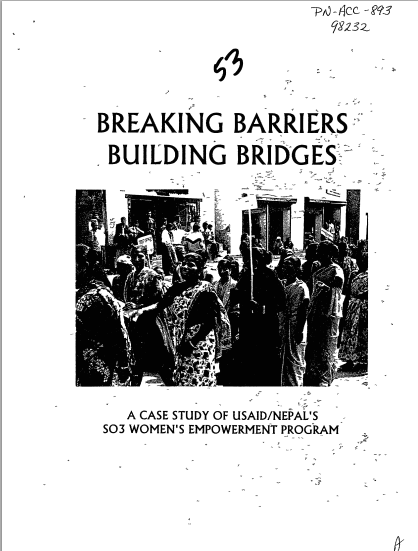
This study presents a “snapshot” of the qualitative, aggregate impact of USAID’s SO3 Women’s Empowerment Program in Nepal. Since its inception in 1995, this program aims to increase women’s literacy, improve the legal environment for females, and foster women’s economc participation in the market economy The main hypothesis of SO3 is that women’s participation in basic literacy, legal literacy, and economic participation activities empowers them to initiate collective social actions and increases their influence in household decision making (in terms of allocation of their own income, household income, and the decision to keep them daughters in school).
The methods used to investigate this hypothesis were a combination of focus group discussions key informants interviews, and direct observation. This case study measured SO3 Impact against indicators developed by USAID/Nepal, namely, (1) the number of women-initiated collective action for social change and (2) the number of women who increase their influence on household decision making. Evaluated against these benchmarks, data from the field clearly shows that women who receive all three SO3 interventions become bolder grassroots advocates, influential and vocal decision makers, better guardians of human health and better protectors of the environment.