
Asylum Access directly empowers refugees to assert their legal rights to employment, free movement, financial access and equal protection under the law. It also advocates directly with governments to change laws so that refugees can move freely, work lawfully, provide for their families and contribute to their host societies.
Network Spotlights are short profile articles focusing on members of the Global Legal Empowerment Network. Spotlight articles use case studies and ‘key lessons’ to provide useful insights into the work of other network members. Whether you are working in the same country, with similar issues or want to understand new legal empowerment approaches, the Network Spotlight is a useful learning resource.
Dynamique Des Femmes Juristes operates in the eastern Democratic Republic of the Congo and facilitates women’s access to justice and fights against impunity. It strengthens the skills of women so they can take part in decision-making bodies in both the public and private sectors; it develops the potential of women so that they engage in the promotion, protection and defense of their rights.
Network Spotlights are short profile articles focusing on members of the Global Legal Empowerment Network. Spotlight articles use case studies and ‘key lessons’ to provide insights into the work of network members. Whether you are working in the same country, with similar issues or want to understand new legal empowerment approaches, the Network Spotlight is a useful learning resource.
The Karenni Social Development Centre (SDC) works to protect the environment in rural Eastern Myanmar and promote the human rights of the Karenni people – in Myanmar and in refugee camps in Thailand. It teaches students non-violent skills to help build a new society and to develop the rule of law in Myanmar.
Network Spotlights are short profile articles focusing on members of the Global Legal Empowerment Network. Spotlight articles use case studies and ‘key lessons’ to provide insights into the work of network members. Whether you are working in the same country, with similar issues or want to understand new legal empowerment approaches, the Network Spotlight is a useful learning resource.
The Koshish Charitable Trust has a mission to educate, organize and empower poor, rural and urban people in Bihar. It works to promote development as a liberating force for achieving social justice, economic growth and self-reliance and to give people a respected status social and economic freedom. It also works for peace and a better environment.
Network Spotlights are short profile articles focusing on members of the Global Legal Empowerment Network. Spotlight articles use case studies and ‘key lessons’ to provide insights into the work of network members. Whether you are working in the same country, with similar issues or want to understand new legal empowerment approaches, the Network Spotlight is a useful learning resource.
Hand-help.ru is a project of Russia’s Human Rights Institute. It uses the internet to improve the legal protection of people who use drugs, and prisoners convicted under Russia’s drug laws, as well as improving the legal knowledge of civil society groups, legislators and lawyers.
Network Spotlights are short profile articles focusing on members of the Global Legal Empowerment Network. Spotlight articles use case studies and ‘key lessons’ to provide insights into the work of network members. Whether you are working in the same country, with similar issues or want to understand new legal empowerment approaches, the Network Spotlight is a useful learning resource.
Proyecto Surcos (‘Furrows Project’) is an interdisciplinary group working in Community Health in Argentina. It promotes healthier living conditions from the resources of each community it serves, through the exchange of knowledge and skills. It has developed a health rights program to empower members of the Guaraní M’bya tribe in the Misiones region of north eastern Argentina.
Network Spotlights are short profile articles focusing on members of the Global Legal Empowerment Network. Spotlight articles use case studies and ‘key lessons’ to provide insights into the work of other network members. Whether you are working in the same country, with similar issues or want to understand new legal empowerment approaches, the Network Spotlight is a useful learning resource.
Click the buttons in the top right of the page to download the Spotlight on Proyecto Surcos or read it online.
Network Spotlights are short profile articles focusing on members of the Global Legal Empowerment Network. Spotlight articles use case studies and ‘key lessons’ to provide useful insights into the work of other network members. Whether you are working in the same country, with similar issues or want to understand new legal empowerment approaches, the Network Spotlight is a useful learning resource.
Through its Good Rural Governance program, the S M Sehgal Foundation engages communities in improving poor conditions and inadequate public services in rural India. It provides vulnerable citizens and the leaders of village-level institutions with the knowledge, skills, and confidence to become informed, active participants in the development of their communities.
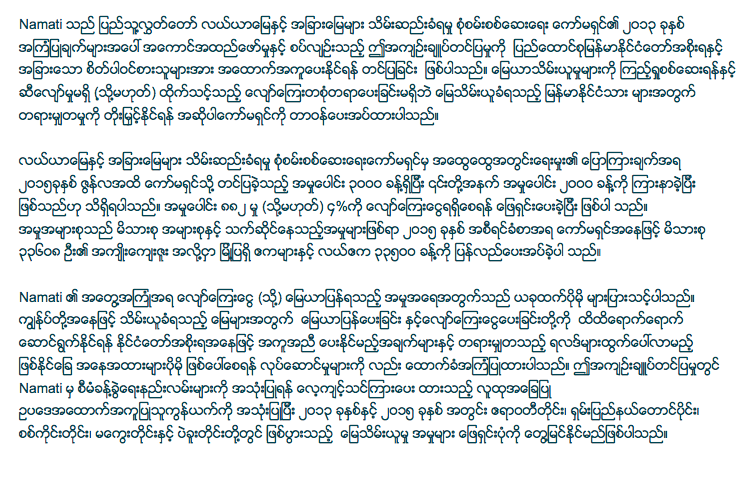
Namati submitted this briefing paper to assist the government of Myanmar and other interested parties in efforts to ensure the implementation of the 2013 recommendations of Parliament’s Farmland Investigation Commission. The commission is tasked with scrutinizing land grab cases and to promote justice for Myanmar’s citizens whose land was taken without due process or compensation.
According to the Secretary General of the Farmland Investigation Commission, as of June 2015, approximately 30,000 cases have been submitted to the Commission, of which about 20,000 have been heard. Of those, a small number of cases (882 or 4%) have been found justified to receive compensation. Many of these are collective cases, and according to the 2015 report, the Commission has returned about 335,000 acres of urban and farmland to benefit 33,608 families.
Namati’s own experience suggests that the number of cases justified to receive compensation or return of land should be much higher. We further recommend actions the government can take to help streamline the return and compensation of grabbed land and improve the likelihood that outcomes are fair and equitable. This briefing draws on Namati’s experience using a network of community paralegals trained to use administrative procedures to resolve land grab cases in Ayeyarwaddy, Southern Shan, Sagaing, Magwe, and Bago between 2013 and 2015.
This paper was prepared for the 3rd UNITAR-Yale Conference on Environmental Governance and Democracy, 5-7 September 2014, in New Haven, USA.
Abstract: Around the world, communities face increasing threats to their lands and ecosystems from large-scale land acquisitions and expropriation for industrial agriculture, mining, deforestation and infrastructure investments. Many of these activities dispossess communities from their lands and lead to environmental degradation, human rights violations, loss of livelihoods, and inequity. While action is needed at national and international levels, local communities and civil society need more immediate and practical tools to protect their lands, natural resources, and ecosystems. Namati is an international organization dedicated to strengthening people’s capacity to exercise and defend their rights in practical ways. Namati specializes in developing innovative ways to empower and mobilize civil society organizations, communities, and vulnerable groups to protect their rights to land, natural resources and a healthy environment.
In this paper, we provide an overview of Namati’s approaches, tools, and research findings. We focus on Namati’s Community Land Protection Program, which since 2009 has supported over 80 communities in Liberia, Uganda, and Mozambique to document, protect, and manage community lands and natural resources. This work has generated unparalleled comparative and cross-national data on the effectiveness of legal empowerment strategies for protecting land and resource rights. We also draw examples from Namati’s work on land rights and environmental justice in Sierra Leone, Myanmar, and India. We offer specific and practical recommendations for policy and practice, focusing on strategies for effective use of paralegals and legal aid to strengthen, defend, and enforce land and environmental rights.