
Recording information about individual cases is extremely important for an effective, organized paralegal program. This one page case tracking form, also known as a case management form or intake form, is used by Namati and the Nubian Rights Forum in Kenya to document work with individual clients. This form is focused on issues of citizenship and identity documentation. It may be used and adapted to other contexts for the purpose of documenting paralegal casework.
Follow Vivek on Twitter here.
Vivek believes we can advance social and environmental justice by deepening democracy.
Vivek started Namati in 2011. Since then, Namati and its partners have supported cadres of community paralegals—sometimes known as barefoot lawyers—in ten countries. These advocates work with their communities to protect common lands, enforce environmental law, and secure basic rights to healthcare and citizenship.
In all ten countries, paralegals and communities have achieved concrete remedies to grave harms as well as major improvements to entire systems, including a new national program in Mozambique to ensure healthcare is accountable to local communities, Myanmar’s first legal commitment to honor the customary land rights of ethnic minorities, and in Sierra Leone, one of the most progressive laws on land, environmental, and climate justice in the world.
Globally, Namati convenes the Legal Empowerment Network, made up of more than 3,000 groups from over 170 countries who are learning from one another and collaborating on common challenges. This community successfully advocated for the inclusion of justice in the 2030 Sustainable Development Goals, and for the creation of the Legal Empowerment Fund, with a goal of putting $100 million into grassroots justice efforts worldwide.
Vivek is co-author of Community Paralegals and the Pursuit of Justice (Cambridge University Press). His TED talk, “How to Put the Power of Law in People’s Hands,” has been viewed over a million times.
Vivek is on the road a lot, but he has a home and family in Washington, DC. He tries to spend time in a forest or other natural place every week, wherever he is.
Vivek studies and teaches capoeira at Universal Capoeira Angola Center.
Work life before Namati
From 2003 to 2007, Vivek co-founded and co-directed the Sierra Leonean organization Timap for Justice, which has been recognized by the International Crisis Group, Transparency International, and President Jimmy Carter for advancing justice in the context of a weak state and a plural legal system.
From 2008 to 2011, he served as senior counsel in the Justice Reform Group of the World Bank. His work focused on rule of law reform and governance, primarily in West Africa and South Asia.
In 1997-1998 he lived in a hut of dung and sticks in a village in Kutch, his native place, working on rainwater conservation and girls’ education with two grassroots development organizations—Sahjeevan and Kutch Mahila Vikas Sanghathan.
Learning, writing, teaching, supporting
Vivek graduated from Harvard College, magna cum laude, and Yale Law School. His undergraduate thesis was called Mohandas, Martin, and Malcolm on Violence, Culture, and Meaning.
Vivek writes regularly—see links to publications below—and co-teaches the Legal Empowerment Leadership Course, which is co-hosted by Central European University and the Bernstein Center for Human Rights at New York University School of Law.
Vivek serves on the boards of Renew New England, which is pursuing a Green New Deal across that region, and the Constitutional Accountability Center, which is focused on fulfilling the progressive promise of the U.S. constitution. He also serves on the advisory council for the Climate Justice Resilience Fund. Vivek was an affiliate expert with the UN Commission on Legal Empowerment and is a member of the global Task Force on Justice.
RECOGNITION
SELECTED PUBLICATIONS
On April 19 and 20, 2012 in Dhaka, Namati, BRAC, Marg, and the Open Society Justice Initiative held a regional meeting on methods of monitoring and evaluating legal empowerment. The gathering brought together more than 50 people from all over the region, representing grassroots groups, development agencies, governments, and evaluation experts. Namati CEO Vivek Maru began the meeting with a story about Akbar and Birbal, a Mughal emperor and his trusted adviser.
This document is the second in the series of community led groundtruthing exercises carried out by the Centre for Policy Research (CPR)-Namati Environmental Justice Program in partnership with Janabhivyakti and Hasdeo Arand Bachao Sangharsh Samiti (HABSS). It highlights the process and findings of an exercise where the representatives of a community affected by mining in central India tried to understand whether the impacts of dust pollution, water contamination and felling of trees faced by them were arising out of the non-compliance of law. They systematically collected evidence and filed well drafted complaints to the concerned institutions who could affect remedies. As the final report establishes, this process led to positive official remedies in some cases. In others, the follow up is ongoing.
This page provides a library of resources relevant to budget monitoring and maternal, reproductive, and sexual health.
Kerri Evelyn Harris is an American activist and currently the Program Advisor for Namati’s U.S. Environmental Justice Program. She works to amplify community voices and empower people to address environmental challenge while advocating for systemic change. Kerri shares her learning journey and what inspires her.
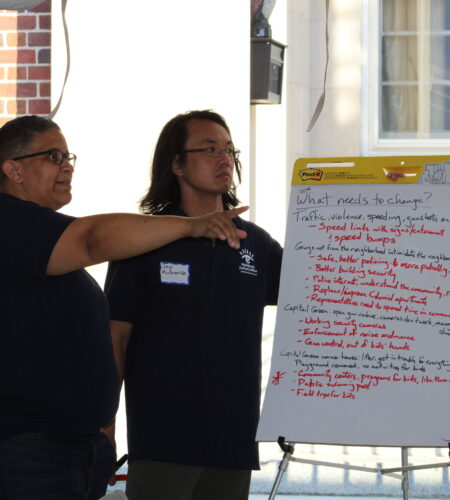
Kerri Harris at a community meeting
I’m the Program Advisor for Namati’s U.S. Environmental Justice Program, based in Delaware. Our work focuses primarily on the Mid-Atlantic region, including Delaware, Maryland, Virginia, and Washington, D.C. We aim to empower communities to address environmental challenges while advocating for systemic change.
I’ve been working in the social justice space for about 15 years now, addressing various justice issues in the U.S., including economic and healthcare justice, criminal justice reform, and environmental justice. I’ve worked both locally, in my home state of Delaware, and nationally – engaging with stakeholders from local to federal government. My work has ranged from advocating for legislative changes to fostering community development and empowerment. This journey has brought me to my current role with Namati.
One person who profoundly influenced me is Maria Payán. Maria lives in Delaware but works across Maryland and Pennsylvania on environmental justice issues. Her journey started when she and her family lived in a community with contaminated water. Her son would develop blisters and a burning sensation on his skin after bathing due to the pollution. That personal experience ignited her passion for environmental justice.
In 2018, Maria and I connected while working on justice issues in Southern Delaware, addressing the pollution from chicken factories and the harmful health impacts on nearby communities. Maria’s tireless commitment to amplifying marginalized voices and her unwavering passion continue to inspire me.
Yes, though it wasn’t initially tied to environmental justice. I served in the military, and after being medically retired, I faced significant challenges finding employment despite meeting all the supposed “success criteria”. That experience opened my eyes to systemic barriers and inspired me to fight for others who might fall through the cracks. It eventually led me to collaborate with incredible advocates like Maria and many others, who’ve mentored and guided me on what it means to be truly people-centered.
Collective action is absolutely key. While one person can shout, a group can create a resounding call for change. When people unite and move as a single voice, it’s harder for decision-makers to ignore them. It also energizes others who might not have considered joining the fight. Collective action amplifies impact and creates momentum for social change.
One moment that stands out is our work in a community where we addressed environmental injustices while building towards solutions.
Initially, local government decision-makers rarely sought community input. But within a year of our engagement, those decision-makers began actively inviting community members to meetings. They saw the value of seeking voices rather than expecting them to come forward. This shift, inspired by Namati’s approach, created a meaningful impact that we’re incredibly proud of.
My kids are my inspiration. If we think things are bad now and do nothing, they’ll only get worse. I want my children to have a better future and to see the value of not living a complacent life. They inspire me to push forward, to fight for change, and to leave behind a better world.

A community rally in Delaware, US
Absolutely. People often talk about the U.S. civil rights movement of the ’50s and ’60s as though it was driven by the majority. But studies show that only 8% of Black Americans—and even fewer from other groups—were actively involved. Yet that small, committed group achieved monumental change.
So, if you ever feel like not enough people are paying attention, remember: you don’t need everyone. You just need a dedicated few. It’s okay to pause when you’re tired—just don’t stop. Find your fellow changemakers in that committed minority, and know that change is possible.
Namati offers this brief in the hope that Myanmar’s national reforms and the implementation of the country’s new National Land Use Policy can grow from the lived experience of ordinary Myanmar citizens. Namati and our partners assist farmers in Myanmar to claim their land rights through a community paralegal approach. Community paralegals are trained in relevant laws, community education, negotiation, and mediation skills to work with farmers to resolve a variety of land rights issues. Dozens of data points are documented as part of each case resolution process that illustrate how the legal framework functions in practice. It is this casework data that underpins this policy brief. Focus groups and interviews with paralegals and clients further provide qualitative context and insights.
Namati recommends actions the Myanmar government can take as part of implementing its new National Land Use Policy to help increase women’s engagement in land use management and access to tenure rights. This briefing also provides recommendations for civil society organizations interested in the community paralegal model, and, in particular, in increasing the number of women paralegals in the country as a means of women’s empowerment.
This resource is in Burmese.
From 2009 until 2015, Namati and its partners Centro Terra Viva (CTV) in Mozambique, Land and Equity Movement in Uganda (LEMU), and Sustainable Development Institute (SDI) in Liberia supported more than 100 communities to document and protect their customary land rights. In late 2017, Namati evaluated the impacts the process had on communities’ responses to outsiders seeking community lands and natural resources.
The study tested the following assumption: “Once communities know their land rights and have documented their land claims, they will act in an empowered way when approached by government officials and/or investors seeking land, and will have improved tenure security outcomes.”
Of the 61 communities assessed, 46% had been approached by outside actors seeking community lands and natural resources since completing their land protection efforts. Overall, the stories recounted by the communities clearly show how, on their own, community land protection initiatives, as they were implemented in Uganda, Liberia, and Mozambique, did not adequately balance the significant power asymmetries inherent in interactions between rural communities and government officials, whether they are coming on their own behalf or accompanying potential investors.
These outcomes were prevalent despite community members’ ability to clearly articulate their legal rights in such situations—and were the same independent of whether or not the community had a formal government-issued document for its land rights (Mozambique); legal private ownership under law (Uganda); or fought the land grab, seeking external support from NGOs and political representatives (Liberia).
This 8-page executive summary captures the study’s key findings and recommendations on how to more effectively address such imbalances of power and strengthen global efforts to protect community land rights.
To access the full report, click here.
From 2009 until 2015, Namati and its partners Centro Terra Viva (CTV) in Mozambique, Land and Equity Movement in Uganda (LEMU), and Sustainable Development Institute (SDI) in Liberia supported more than 100 communities to document and protect their customary land rights. In late 2017, Namati evaluated the impacts the process had on communities’ responses to outsiders seeking community lands and natural resources.
The study tested the following assumption: “Once communities know their land rights and have documented their land claims, they will act in an empowered way when approached by government officials and/or investors seeking land, and will have improved tenure security outcomes.”
Of the 61 communities assessed, 46% had been approached by outside actors seeking community lands and natural resources since completing their land protection efforts. Overall, the stories recounted by the communities clearly show how, on their own, community land protection initiatives, as they were implemented in Uganda, Liberia, and Mozambique, did not adequately balance the significant power asymmetries inherent in interactions between rural communities and government officials, whether they are coming on their own behalf or accompanying potential investors.
These outcomes were prevalent despite community members’ ability to clearly articulate their legal rights in such situations—and were the same independent of whether or not the community had a formal government-issued document for its land rights (Mozambique); legal private ownership under law (Uganda); or fought the land grab, seeking external support from NGOs and political representatives (Liberia).
The stories described in this report illustrate broad-based corruption that allows land to be claimed by powerful elites and government institutions with little regard for required legal procedures.
By showcasing the rampant injustices the study communities faced, this report aims to shed light on how to more effectively address such imbalances of power and strengthen global efforts to protect community land rights.
For an 8-page executive summary of study’s key findings and recommendations, click here.
This publication highlights the non-compliances to environmental regulation and the impacts it has on the lives and livelihoods of affected communities due to coal mining projects undertaken by Mahanadi Coalfields Limited (MCL) in Hemgir block of Sundargarh district in the state of Odisha. A participatory process called “groundtruthing” was initiated with the cooperation of community leaders, activists from the Centre for Integrated Rural and Tribal Development (CIRTD), Sundargarh and researchers from the Centre for Policy Research (CPR)-Namati Environmental Justice Program, New Delhi.
Through the process of groundtruthing, it was found that conditions that environmental regulatory authorities have fixed for mining projects are not complied with. As a result, a number of issues and adverse impacts have emerged, impacting the lives and livelihoods of people living in the areas surrounding the mines. It was learned that affected people, community representatives or activists could collect information and data from the field as well as from the concerned authorities to find the gap between regulatory conditions and compliance with them. They cooperated with each other to find out the gaps and then sought remedial measures by approaching the concerned regulatory authorities. Through this groundtruthing process the people of affected communities were empowered as they learnt the law, how to collect evidence of non-compliance and which institution to approach. It could go on to help in strengthening not only the regulatory mechanism to frame new rules and conditions for redressing grievances of aggrieved people,. We are thankful to the concerned authorities who provided the required information and their subsequent responses towards providing remedial measures.