
SALIGAN envisions a Philippines society that is just, peaceful, compassionate, and liberating:
One where each person is free to live a life more fully human, unfettered by poverty, violence, prejudice, and discrimination;
Where the rights of everyone are respected and advanced, regardless of race, creed, sex, sexual orientation, gender identity or expression, culture, or ethnic or regional origin.
SALIGAN envisions a state that is sovereign, progressive and democratic:
One where women, the basic sectors and local communities actively engage in all levels of governance and policy-making; Where there is respect for peoples’ right to self- determination;
Where political power is pursued to ensure the welfare of all, and to correct unjust social relations.
SALIGAN envisions a national economy that is sustainable, self-reliant, and inclusive:
One where women, the basic sectors and local communities participate in allocating resources and directing growth; Where wealth is distributed to ensure the innate dignity of all.
SALIGAN envisions an environment that is healthful, balanced and sustainable:
Where peoples manage natural resources within the communities responsibly and equitably.
SALIGAN envisions a legal system that is reflective, dynamic, inclusive and accessible:
One where women, the basic sectors and local communities freely advocate their causes and assert their rights; Where laws and remedies are employed as instruments of justice, equity, peace and development.
SALIGAN envisions a people who live in hope:
A people who, in the face of the sufferings around and inside them, trust in their power to transcend.
The Paralegal Alliance Network (PAN) is a consortium of 15 non-governmental Legal Aid Service Providers (LASPs) in Zambia. PAN’s mission is to leverage the collective power of its network members to improve access to justice for all indigents including persons with disabilities thus challenging the acute discrimination experienced by this constituency throughout the justice chain. Formed in 2000, PAN was registered as a company by guarantee under PACRA and as an NGO under the NGO Act in 2013.
The aim of PAN is to enhance the capacity of its member organisations in offering legal aid services to the poor and vulnerable groups, by strengthening the role of paralegals in the justice system.
The network collaborates with training institutions such as the National Institute for Public Administration (NIPA), the University of Zambia (UNZA) and the Zambia Institute of Advanced Legal Education (ZIALE) to develop curriculum and train paralegals. The developed curricula were approved by the Ministry of Education through the Technical Vocation Education Training Authority (TEVETA) and the School of Law at the University of Zambia that supports Skills Award certified community-based paralegal trainings through accreditation. PAN Secretariat coordinates paralegal trainings for member organisations to ensure consistency and accountability of developed standards.
PAN also collaborates with various key state departments and institutions to ensure access to justice for all. PAN is a member of the Communication, Cooperation and Coordination Initiative under the Access to Justice Programme in the Ministry of Justice.
Since PAN’s inception, more than 1,000 paralegals have been trained. The network also developed reference and training manuals for paralegals. Year by year members have been able to see an increase in cases handled by paralegals, an indication that the Zambian population increasingly utilizes paralegal services.
Gibrilla began his career at the Centre for Economic and Social Policy Analysis (CESPA) and Statistics Sierra Leone, working in survey research and statistical analysis. He has experience across the telecom, microfinance, printing, consultancy and media services industries across a number of companies, for example Africell SL Limited, Pernix Serka LLC at the United States Embassy in Sierra Leone, and A Call to Business Group of Companies, where he has held positions such as Junior Accountant, Finance & Logistics Officer, Principal Accountant, Operations Accountant, Account Supervisor and Head of Section.
Gibrilla holds an Advanced Diploma in Accounting and Finance from the Institutes of Commercial Management – UK, and a Certification in Project and Quality Management Systems ISO 9001 2008 from the Canadian Standards Association Group.
This short paper examines the proliferation of land reform throughout the African continent, finding similarities amongst national policies and identifying key strengths and weaknesses. Broadly speaking, the author notes two important developments regarding land policy, governance, and administration in Africa: an upgraded legal standing for customary land rights and a growing shift towards decentralized local and community-based systems of land administration. In addition to the strengthening of customary rights and the simplification of registration procedures for traditionally held lands, governments, stimulated in part by international donors, have placed growing emphasis upon collectively held or common properties including forests, woodlands, and pastures. According to the author, land policy reforms enacted in Tanzania, Lesotho, and Uganda are most exemplary of recognized best practices, including the heightened participation of land holders in governance and administration decisions, the strengthening of common property rights, and the introduction of restrictions upon the state’s authority to interfere in local land administration and to appropriate land for the public interest. Despite possessing the most advanced legislative frameworks, these countries still suffer from deficiencies in implementation and other pressing weaknesses such as a wavering political will to safeguard customary rights to land and a lack of capacity among local administrators and leaders to effectively exercise authorities devolved from central government.
Keywords: decentralization, customary land tenure, best practices, land registration, common property, state appropriation of community lands.
This paper presents the results of survey research conducted in Bangladesh during the period November 2000 through January 2001, as a supplement to the seven-country Legal Empowerment Study undertaken under Asian Development Bank Regional Technical Assistance 5856. The research examined the impact of legal empowerment, which is the use of law to increase disadvantaged populations’ control over their lives, on selected aspects of sample groups’ legal knowledge, economic well being, gender equity, and participation in local governance.
Legal empowerment differs from the more general notion of empowerment in that it involves the explicit or implicit use of the law (for example, through training, counseling, or litigation) or relates to public decision-making processes that have a specific legal dimension (for example, equipping citizens or communities with the skills and confidence to appear before an administrative tribunal or to inform local policy development). It frequently combines such activities with initiatives that are not inherently law-oriented, such as community organizing or livelihood development. While they typically include education, most advanced legal empowerment initiatives aim to do more than simply teach people about law. They provide the disadvantaged with opportunities to apply their knowledge through actions that are intended to advance their legal rights, improve their quality of life, or increase their participation in public decision making.
The survey involved a controlled comparison of three different approaches to legal empowerment to determine differences in impact on beneficiary populations, as well as demographically similar control samples. The three nongovernmental organizations (NGOs) selected for the survey were: (i) the Madaripur Legal Aid Association (MLAA), which specializes in educating citizens about the law and providing a variety of legal services, notably mediation; (ii) Samata, which concentrates on mobilizing communities to apply the law through mass-based advocacy initiatives; and (iii) Banchte Shekha, which provides mediation and other legal services as part of an integrated development strategy for women.
This paper presents the results of a study on the impact of legal empowerment activities on the implementation of agrarian reform in two provinces in southern Philippines. The study was undertaken as a supplement to the seven-country Legal Empowerment Study conducted under Asian Development Bank Regional Technical Assistance 5856.
Legal empowerment, or the use of law to increase disadvantaged populations’ control over their lives, differs from the more general notion of empowerment in that it involves the explicit or implicit use of the law (for example, through training, counseling, or litigation) or relates to public decision-making processes that have a specific legal dimension (for example, equipping citizens or communities with the skills and confidence to appear before an administrative tribunal or to inform local policy development.) It frequently combines such activities with initiatives that are not inherently law-oriented, such as community organizing or livelihood development. While they typically include education, most advanced legal empowerment initiatives aim to do more than simply teach people about law. They provide the disadvantaged with opportunities to apply their knowledge through actions intended to advance their legal rights, improve their quality of life, or increase their participation in public decision making.
The basic analytical strategy for this study was to compare areas in which nongovernmental organizations (NGOs) were conducting legal empowerment strategies with comparable places where no such work was conducted. This paper reviews the law on land reform and the related legal empowerment work of NGOs, then analyzes three kinds of data collected in the study. These are: (i) judgmental data based on the independent observations and impressions of agrarian reform officials; (ii) quantitative data from a survey conducted in four communities (two with legal empowerment activities and two without); and (iii) the results of focus group discussions in those four communities.
The Environment Institute of Kenya (EIK) is the premier professional body for environmental practitioners in Kenya, established in 2014 to regulate the profession and promote excellence in environmental management. As a cornerstone of the country’s sustainability agenda, the Institute provides a platform for experts from diverse backgrounds—including academia, government, the private sector, and civil society—to collaborate on critical issues such as climate change, biodiversity conservation, and environmental governance.
The EIK is dedicated to enhancing environmental professionalism through:
Standards and Regulation: Establishing and maintaining rigorous ethical codes and professional standards for environmental assessment and management.
Capacity Building: Providing continuous professional development (CPD) through specialized training in areas like ESG reporting, carbon trading, and environmental impact assessments.
Advocacy and Policy: Influencing national and regional policy frameworks to foster a “green transition” and climate resilience.
Knowledge Dissemination: Hosting conferences and webinars to share research and innovative solutions for sustainable development.
EIK offers several membership categories tailored to professional growth, including:
Associate Membership: For early-to-mid career practitioners building practical experience.
Full and Lead Membership: For senior experts with advanced degrees and extensive field experience.
Through its commitment to education, advocacy, and community engagement, the Environment Institute of Kenya ensures that the country’s development pathways are ecologically sound and socially equitable. It remains the vital link between environmental science and actionable policy, empowering its 6,000+ members to lead Kenya toward a more sustainable and climate-resilient future
Mohammad Muzaffar Faisal is a seasoned environmental professional with over a decade of experience in environmental science, advocacy, and conservation in Bangladesh. He shares his learning journey and what inspires him to do his work.
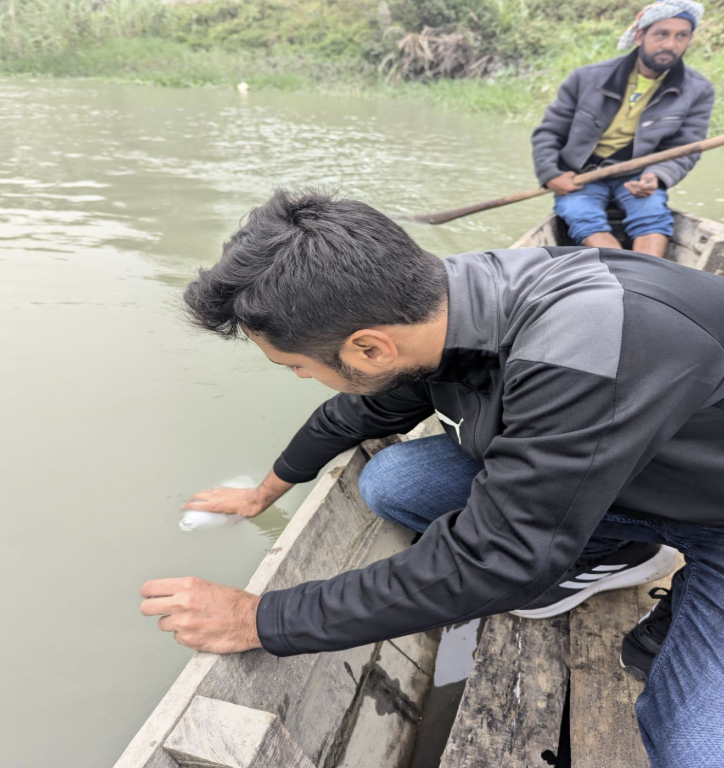
Faisal conducting water quality testing of a river called Shomeshwari
Please introduce yourself briefly and tell us about your work.
I currently, I serve as an Awareness and Campaign Officer at the Bangladesh Environmental Lawyers Association (BELA), where I support initiatives aimed at raising public awareness and promoting environmental justice. My work involves writing concern letters on pressing environmental issues, organizing awareness campaigns and advocacy events, and managing related documentation and reporting.
Throughout my career, I have held key positions in organizations such as SAJIDA Foundation, Nowabenki Gonomukhi Foundation, and the Creative Conservation Alliance, contributing to projects on climate change, disaster management, and biodiversity conservation. I hold both a Master’s and Bachelor’s degree in Environmental Science from North South University. I’ve also contributed to several research studies and peer-reviewed publications on topics including climate change, species conservation, and ecosystem health.
At BELA, I bring together my skills in environmental policy advocacy, stakeholder engagement, public awareness, and field-based research to advance our mission of legal empowerment and environmental protection. My work is further supported by advanced training in GIS, conservation project planning, and humanitarian standards. I remain committed to promoting sustainable development and ensuring environmental justice for communities across Bangladesh.
One pivotal experience that deeply motivated me was the Sat Masjid Road tree-cutting incident in Dhanmondi, Dhaka, in January 2023. The Dhaka South City Corporation (DSCC) initiated a so-called beautification project, which led to the removal of nearly 600 trees—done mostly at night and without consulting residents. These trees were vital to the local ecosystem and quality of life in Dhanmondi, one of the few remaining green areas in the city. Despite public outrage, community protests, and human chains, DSCC continued the project, claiming it would widen the divider and replace the trees with flowering shrubs. BELA stood firmly with the community, organizing press conferences, legal scrutiny, and protest marches to halt the destruction. The Mayor’s dismissive attitude and reported threats to demonstrators only reinforced the urgent need for legal intervention and accountability.
Witnessing the unity between legal professionals, environmentalists, and everyday citizens during this crisis strengthened my commitment to environmental justice. It showed me the critical role law and advocacy can play in protecting not just nature—but also people’s right to live in a healthy, sustainable environment.
Yes, there was a significant turning point in my life that greatly shaped my personal and professional journey. Early in my career, I co-founded a conservation-focused organization alongside a few other passionate conservationists. While the vision was strong, we faced numerous challenges—ranging from securing funding, navigating government approvals, dealing with bureaucratic hurdles, to managing internal issues like power dynamics, broken chains of command, and maintaining work-life balance. Due to philosophical differences and a lack of experience, some of us, including myself, decided to step away from the organization.
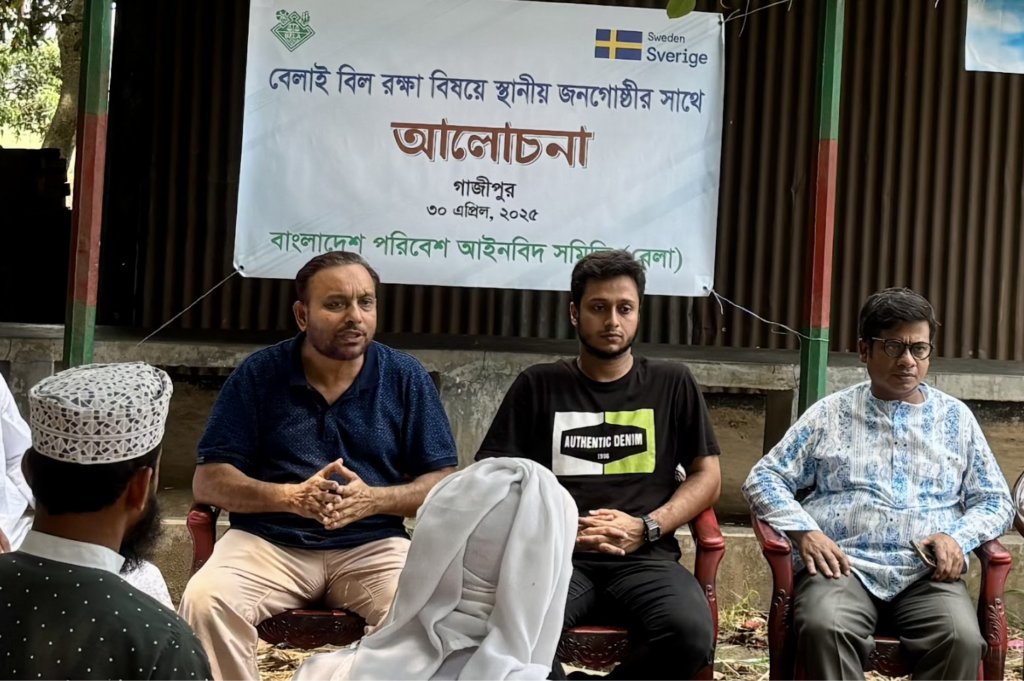
Faisal conducting a community engagement event
Recognizing that we needed more knowledge and practical experience, I made a difficult decision to leave my city and work in remote areas of the country under harsh and vulnerable climatic conditions. During this period, I took up various roles in different organizations, learning how things actually work on the ground—especially in terms of organizational management, stakeholder engagement, and field-level conservation practices. Eventually, I returned to my city and joined BELA, bringing with me a wealth of practical knowledge. That entire journey—leaving behind the comfort of home and stepping into the unknown—was a defining chapter in my life. It taught me resilience, adaptability, and the value of real-world experience, which continues to guide me in my work today.
This work is indeed challenging, and the path I chose wasn’t an easy one. I had to leave my city, my home, and even my family in search of the knowledge and experience I believed were essential for my growth. Many people around me questioned my decision and even suggested that I was making a mistake. But deep down, I was determined to prove them wrong—not out of pride, but because I truly believed in the journey I had chosen.
What keeps me motivated is that sense of purpose—to demonstrate that with dedication and the right mindset, growth and success are achievable even in the most difficult circumstances.
The support of my family, especially my wife, played a crucial role during this time. Her encouragement gave me strength during moments of doubt and exhaustion. That emotional support, combined with my inner drive to learn and contribute meaningfully to the field of conservation, continues to inspire me every day.
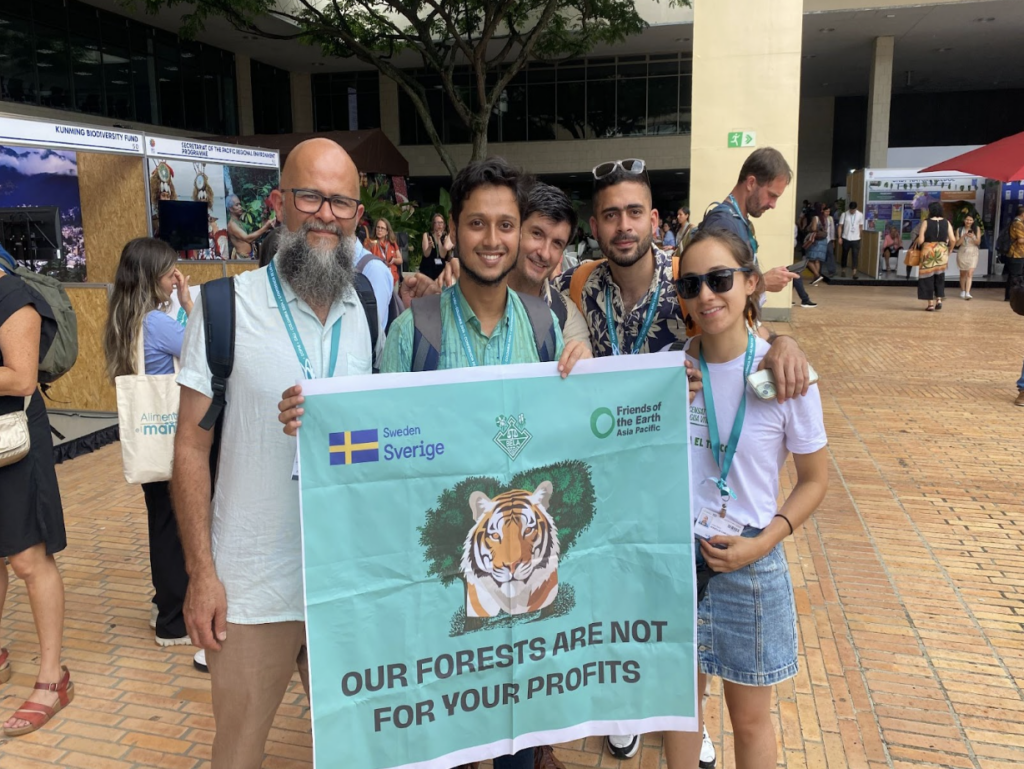
Faisal during a community engagement event
While I am still in the early stages of engagement, I would encourage fellow members to stay grounded in community voices and always prioritize inclusive participation—especially of marginalized and vulnerable groups—in environmental and legal advocacy. Collaboration across countries and contexts can create powerful momentum, especially when we share tools, strategies, and stories that empower local communities to assert their rights. I also believe there’s great value in integrating legal approaches with grassroots activism, as both are essential to achieving sustainable justice.
Christ (Deemed to be) University, India, established in 1969 and managed by the Carmelites of Mary Immaculate (CMI), is one of India’s leading private universities known for its motto “Excellence and Service.” Accredited with an A+ grade by NAAC, the university gained deemed-to-be-university status in 2008 and has since expanded across multiple campuses — including the Central Campus on Hosur Road, Kengeri, Bannerghatta Road, and Yeshwanthpur, as well as off-campuses in Delhi NCR and Pune (Lavasa). Christ University offers a wide range of undergraduate, postgraduate, and doctoral programmes in Arts, Science, Commerce, Law, Engineering, Management, and Social Sciences. The institution boasts modern infrastructure with advanced libraries, laboratories, hostels, sports complexes, and digital learning systems. Home to more than 30,000 students and 1,100 faculty members, it provides a vibrant and diverse academic community. Known for its disciplined academic culture and holistic education approach, the university emphasizes research, ethics, and social engagement. While its strong reputation, infrastructure, and global exposure attract students from across India and abroad, it is also known for its strict attendance and dress code policies, as well as relatively higher fees compared to public universities.